
Solar-powered irrigation offers lifeline as drought fuels hunger in Karamoja

Solar-powered irrigation offers lifeline as drought fuels hunger in Karamoja
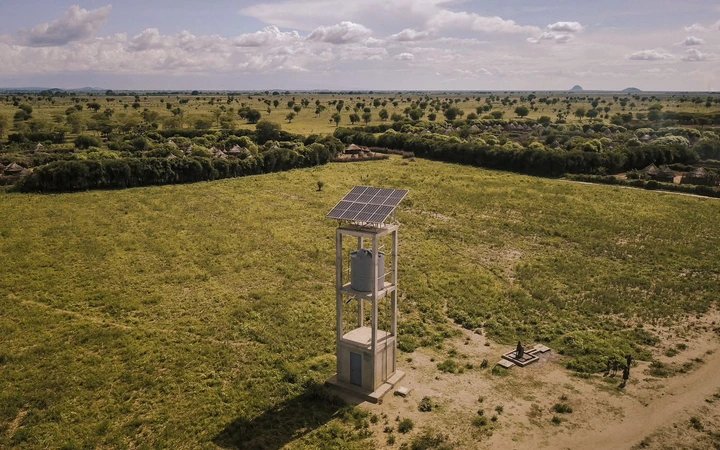
A solar-powered irrigation project in Nakapiripirit District is helping families grow food throughout the year despite prolonged drought, offering a practical solution to recurring hunger crises that have devastated livelihoods across Karamoja.
As prolonged drought tightens its grip on Karamoja and pushes thousands of households deeper into food insecurity, a solar-powered irrigation scheme in Nakapiripirit District is helping communities defy the harsh climate by producing food throughout the year.
In Kawach Sub-county, once-barren land has been transformed into thriving vegetable gardens, where farmers are harvesting crops despite erratic rainfall that has crippled agriculture across much of the sub-region.
The transformation has been driven by a solar-powered water system constructed by Innovation: Africa, providing a reliable supply of water for irrigation, livestock and domestic use.
Programme Officer Charles Losike said the project was designed to tackle one of Karamoja's biggest challenges—unreliable access to water.
"The solar-powered water system is enabling communities to irrigate crops throughout the year, improving food production and helping families become more resilient to prolonged drought," he said.
The intervention comes at a time when prolonged dry spells continue to destroy crops, dry up pasture and leave many households dependent on humanitarian food assistance.
Karamoja has endured repeated climate shocks over the past decade, with droughts, failed harvests and livestock losses combining to deepen poverty and malnutrition in one of Uganda's most vulnerable regions.
Government and humanitarian agencies have repeatedly warned that climate change is increasing the frequency and severity of these crises, making investment in climate-resilient agriculture increasingly urgent.
For residents of Kawach, however, access to irrigation is beginning to change that narrative.
Peter Lotukei, the Parish Chief of Nawanatau, said many families have watched their livelihoods collapse because of unpredictable weather.
"Many families have lost their harvests because of prolonged drought. In some communities, people have died as a result of hunger. Sustainable irrigation offers one of the solutions to reducing these recurring crises," he said.
Beyond boosting food production, the project has also solved another long-standing challenge—access to safe drinking water.
Before the solar-powered system was installed, residents often trekked long distances to collect water from open ponds and seasonal sources that were also used by livestock, exposing families to waterborne diseases and consuming valuable time that could otherwise be spent on farming and other productive activities.
Resident Icumari Macelina said the project has transformed life in the community.
"We now have water throughout the year. We can grow vegetables, feed our families and no longer spend hours looking for water," she said.
Innovation: Africa has rolled out similar solar-powered water systems in several communities across Nakapiripirit and Nabilatuk districts, targeting areas that have repeatedly been affected by drought and food shortages.
Nakapiripirit Chief Administrative Officer Charles Lokoroi said expanding the model could significantly reduce hunger across Karamoja.
"If more communities receive similar irrigation projects, food insecurity will reduce significantly. This is a sustainable solution that can help save lives and improve household incomes," he said.
Agricultural experts have increasingly identified irrigation as one of the most effective climate adaptation measures for Uganda's semi-arid regions.
Unlike rain-fed farming, irrigation enables farmers to grow crops throughout the year, diversify production and cushion households against prolonged dry spells that have become more frequent due to climate change.
For the people of Kawach, the results are already visible. Where drought once left fields bare and families uncertain about their next meal, green vegetable gardens now stand as evidence that access to reliable water can transform livelihoods and offer a sustainable pathway out of recurring hunger.


 Government will not gazette Kijanangoma as King of Tooro for now - Attorney General insists
Ultimate Uganda
Government will not gazette Kijanangoma as King of Tooro for now - Attorney General insists
Ultimate Uganda
 King Oyo’s Body to Arrive Thursday
Ultimate Uganda
King Oyo’s Body to Arrive Thursday
Ultimate Uganda
 Besigye, Lukwago expected to meet Gen. Salim Saleh today at Kapeeke
Ultimate Uganda
Besigye, Lukwago expected to meet Gen. Salim Saleh today at Kapeeke
Ultimate Uganda
 Rwabwogo Advised to ‘Eat His Bishop’ As MK Prepares to Enter State H’se: PREZ MUSEVENI ON HIS WAY OUT
Ultimate Uganda
Rwabwogo Advised to ‘Eat His Bishop’ As MK Prepares to Enter State H’se: PREZ MUSEVENI ON HIS WAY OUT
Ultimate Uganda
0 Comments