
Judges Explore Uganda’s Oil Projects to Better Handle Future Petroleum Cases
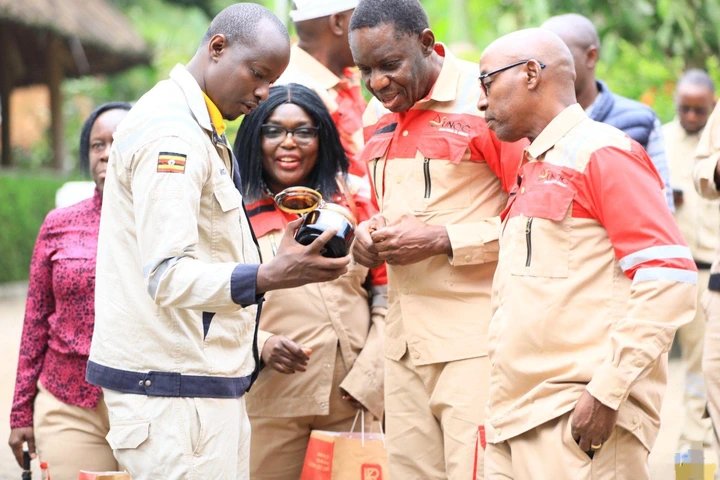

A delegation of senior Judicial Officers has embarked on a three-day field study tour of Uganda’s oil and gas operational areas in the Albertine Graben, an initiative aimed at equipping judges with practical knowledge of the country’s petroleum industry as it prepares for commercial oil production.
The study visit, organised by the Judicial Training Institute (JTI) in partnership with the Uganda Revenue Authority (URA), the Petroleum Authority of Uganda (PAU), the Uganda National Oil Company (UNOC), the Uganda Wildlife Authority (UWA), and the National Council of Sports (NCS), brings together Justices of the Supreme Court and Court of Appeal, as well as selected High Court judges.
Chief Justice Dr Flavian Zeija is leading the delegation, which was received at the Uganda Petroleum Institute Kigumba (UPIK) by the institute’s Principal, Bernard Ongodia.The visit comes at a critical time as Uganda moves closer to first oil, with the Judiciary expected to play a central role in resolving disputes arising from one of the country’s largest-ever investments.
Opening the programme before the delegation departed for the Albertine Graben, Bank of Uganda Governor Dr Michael Atingi-Ego said the country’s oil and gas industry rests not only on infrastructure and natural resources, but also on strong institutions capable of inspiring confidence among investors and citizens alike.Addressing the judges, Atingi-Ego likened the roles of the central bank and the Judiciary to custodians of two forms of public trust.
“The Bank of Uganda protects confidence in money… The Judiciary protects confidence in justice,†he said, arguing that neither can function effectively without the other. He noted that investors commit capital only when they have confidence that contracts, property rights and legal disputes will be handled fairly and predictably by the courts.
He said recent progress on the East African Crude Oil Pipeline (EACOP), the Tilenga and Kingfisher oil developments represents more than US$12 billion in committed investment, describing it as the largest concentration of long-term investment Uganda has ever hosted.While Uganda’s petroleum resources attracted investors, he said, confidence in the country’s legal and institutional framework ultimately convinced them to invest.
According to Atingi-Ego, the rule of law remains the foundation of responsible petroleum governance because it gives investors confidence, assures citizens that national resources will be managed in the public interest, and provides the legal safeguards necessary for sustainable development.
He added that responsible petroleum governance extends beyond oil extraction to include transparent licensing, protection of property rights, effective dispute resolution, environmental protection, respect for affected communities, decent employment and local participation.
Chief Justice Zeija welcomed the initiative, saying the Judiciary must move beyond theoretical knowledge to understand sectors that are shaping Uganda’s economy.â€We should not remain theoretical. It is important that we understand firsthand what is happening in sectors that are critical to the country’s development,†he said.
The field visit is intended to expose Judicial Officers to the operational, regulatory, environmental, labour and community dimensions of the petroleum sector, helping them appreciate the complexities behind disputes that may eventually come before the courts.UPIK Principal Bernard Ongodia told the delegation that the institute has become a centre of excellence for oil and gas training, serving Uganda and the wider African region. He later conducted a guided tour of the institute’s specialised training facilities. The Governor also cautioned that Uganda’s greatest challenge could emerge after oil production begins.
He noted that petroleum revenues are expected to start flowing within months, bringing with them the risk of “Dutch disease,†where a surge in foreign exchange strengthens the local currency and weakens other productive sectors such as agriculture and manufacturing.
To guard against that risk, Atingi-Ego said the Public Finance Management Act requires petroleum revenues held in the Petroleum Revenue Investment Reserve to be invested offshore rather than injected directly into the domestic economy. He added that the Bank of Uganda’s recent domestic gold purchase programme is helping prepare the institution for the prudent management of future petroleum wealth. He stressed, however, that sound legislation alone would not be enough.
“The durability of our fiscal and monetary frameworks depends not only on sound legislation, but also on consistent interpretation and faithful application of the law,†he told the judges.
Looking ahead, Atingi-Ego said Uganda’s courts should prepare for increasingly complex disputes involving land compensation, environmental claims around protected areas such as Murchison Falls National Park, decommissioning liabilities, cross-border issues relating to the pipeline into Tanzania, and cases built on satellite imagery and digital evidence rather than paper records.
He said these emerging issues underscore the need for a modern Judiciary that understands the realities of the petroleum sector. The first day of the field study concluded with a visit to Hoima City Stadium, where National Council of Sports Chairperson Ambrose Tashobya guided the delegation through the facility.
The Judicial Officers also played a friendly football match against Alexo Soccer Academy.Chief Justice Zeija commended the National Council of Sports for hosting the Judiciary and described Hoima City Stadium as an international-standard facility that demonstrates Uganda’s investment in modern sports infrastructure.
Tashobya said the stadium is one of the flagship facilities being developed as Uganda prepares to co-host the 2027 Africa Cup of Nations (AFCON), adding that continued investment in sports infrastructure is essential for nurturing talent and promoting national development.
The Judiciary delegation will spend the coming days visiting key petroleum facilities across the Albertine Graben as Uganda seeks to ensure that its courts are prepared to handle the legal, commercial and environmental questions that will accompany the country’s transition into an oil-producing nation. URN


 Government will not gazette Kijanangoma as King of Tooro for now - Attorney General insists
Ultimate Uganda
Government will not gazette Kijanangoma as King of Tooro for now - Attorney General insists
Ultimate Uganda
 King Oyo’s Body to Arrive Thursday
Ultimate Uganda
King Oyo’s Body to Arrive Thursday
Ultimate Uganda
 Besigye, Lukwago expected to meet Gen. Salim Saleh today at Kapeeke
Ultimate Uganda
Besigye, Lukwago expected to meet Gen. Salim Saleh today at Kapeeke
Ultimate Uganda
 Rwabwogo Advised to ‘Eat His Bishop’ As MK Prepares to Enter State H’se: PREZ MUSEVENI ON HIS WAY OUT
Ultimate Uganda
Rwabwogo Advised to ‘Eat His Bishop’ As MK Prepares to Enter State H’se: PREZ MUSEVENI ON HIS WAY OUT
Ultimate Uganda
0 Comments