
Hut 8 Scam: Ugandans Count Losses as PDM Beneficiaries, Students and Families Lose Millions
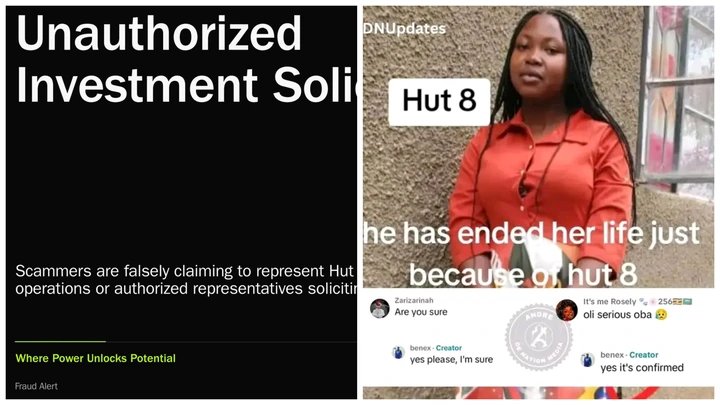

More than Shs5 billion is emerging as an estimated loss, although authorities have not yet published a final audited figure.
Victims include PDM beneficiaries and university students who reportedly invested savings, tuition and borrowed money.
The legitimate Hut 8 has warned Ugandans that it has no authorised representatives soliciting investments in Uganda and does not solicit investments through WhatsApp, Telegram, Facebook groups, direct messages or local agents.
KAMPALA — What began for thousands of Ugandans as an online opportunity to make quick money has turned into a financial nightmare, with victims of the controversial Hut8digital investment platform now counting losses running into billions of shillings.
Reports from across the country indicate that victims include Parish Development Model (PDM) beneficiaries, university students, market vendors, farmers, small business owners and salaried workers who deposited money hoping to multiply their savings within a short period.
Although the full extent of the losses has not been officially established, emerging estimates put the amount lost by Ugandans at more than Shs5 billion. Authorities have yet to complete an assessment of the scheme, meaning the eventual figure could be higher.
The platform appears to have operated separately from the legitimate North American company Hut 8, whose name and corporate identity were allegedly used to create an impression of legitimacy.
Hut 8 issues warning to Ugandans
The legitimate Hut 8 has now issued a direct warning over scammers falsely claiming to represent the company and soliciting investments in Uganda.
In a notice to the public, Hut 8 said it has no operations or authorised representatives soliciting investments in Uganda.
The company specifically warned that it does not solicit investments through WhatsApp, Telegram, Facebook groups, direct messages or local agents.
“Please remain vigilant, do not send funds, and verify company information only through Hut 8’s official website and investor relations page,” the company warned.
Warning: We have received reports of scammers falsely claiming to represent Hut 8 and soliciting investments in Uganda.
Hut 8 has no operations or authorized representatives soliciting investments in Uganda. Hut 8 does not solicit investments through WhatsApp, Telegram, Facebook… pic.twitter.com/yynP1Uzxus
— Hut 8 (@Hut8Corp) August 11, 2026
The statement provides a crucial distinction for Ugandans who may have believed that the Hut 8 investment platform was connected to the legitimate company.
The official company directs investors to verify information through hut8.com/investors.
The warning also means that anyone currently claiming to be a Hut 8 investment agent in Uganda should be treated with extreme caution unless independently verified through the company’s official channels.
From PDM money to university tuition
Among the most painful stories are those of people who invested money they could not afford to lose.
Some PDM beneficiaries reportedly put portions of their funds into the platform after being persuaded that they could quickly grow the money. Others were recruited through WhatsApp groups, social media and face-to-face community networks.
University students were also caught in the frenzy.
One widely circulated account involves a Makerere University student who reportedly deposited about Shs1.5 million, described as his semester tuition, after being promised a much larger return. When withdrawals became difficult, the money was reportedly left locked in the platform.
Other students are said to have invested hostel fees, examination money and borrowed funds after seeing early users appear to make profits.
For some, the consequences go beyond financial loss.
Students facing tuition deadlines have reportedly been left anxious and depressed, with some fearing that they may be unable to return to campus or complete their studies.
A victim quoted in online discussions described borrowing money from a friend to top up a Hut 8 account, only to lose access to the funds.
Such testimonies illustrate how quickly an online investment scheme can turn into a personal crisis when people invest money meant for basic needs.
‘People believed because they saw others making money’
The scheme reportedly gained credibility by allowing some users to withdraw money in its early stages. This created a powerful word-of-mouth effect, encouraging existing users to recruit friends, relatives and colleagues.
The platform was reportedly promoted through social media, WhatsApp groups and community networks, with some recruiters approaching potential investors directly.
That pattern is familiar in investment scams: early payments can create confidence, while aggressive referrals bring in new money before withdrawals eventually become restricted.
Concern over victims’ mental health
The financial fallout has also created growing concern about the emotional wellbeing of victims.
There have been disturbing accounts online of people experiencing severe anxiety, hopelessness and depression after losing savings, borrowed money and school fees.
There are also circulating claims of suicide linked to the collapse. However, these claims have not been independently verified by police or other authorities and should not be presented as confirmed casualties.
Former Leader of the Opposition Winnie Kiiza, who has a strong connection to Kasese and the wider Rwenzori region, is among public figures whose voice can add to the growing conversation around protecting ordinary Ugandans from financial exploitation.
The central message for victims, however, should be clear: losing money does not mean losing one’s life or future.
Families, universities, community leaders and mental-health professionals need to support victims rather than blame them.
Who is regulating the scheme?
One of the biggest challenges is determining who exactly is behind the platform.
Reports indicate that the operators relied heavily on digital channels, including social media, Telegram and WhatsApp, rather than maintaining an easily identifiable physical operation in Uganda.
That creates a serious enforcement challenge.
A platform can target thousands of Ugandans from outside the country while having no obvious office, directors or assets locally accessible to investigators.
The official Hut 8 warning makes the distinction particularly important: the legitimate Hut 8 says it has no operations or authorised representatives soliciting investments in Uganda.
Therefore, Ugandans who deposited money into Hut8digital should not assume that the legitimate Canadian company is responsible for the platform or that its assets can automatically be pursued in Uganda.
Ugandans warned: verify before depositing
The Hut 8 episode is another reminder that a professional-looking website, growing WhatsApp group or successful withdrawal by a friend is not proof that an investment is legitimate.
Ugandans should verify the identity of the company, its physical presence, licensing status and the people behind it before depositing money.
Most importantly, never send investment money to a person simply because they claim to be an agent or representative of an international company.
Anyone who has lost money should preserve mobile-money and bank transaction records, screenshots, usernames, phone numbers, referral details, Telegram and WhatsApp conversations and receipts. Such information may assist investigations.
As more victims come forward, the true scale of the Hut 8 fallout may become clearer.
For now, the stories emerging from PDM beneficiaries, university students and ordinary families paint a disturbing picture: billions of shillings may have disappeared into an online investment operation whose operators remain difficult to identify.


 Starlink goes live in Uganda; price comparisons against MTN, Airtel
Ultimate Uganda
Starlink goes live in Uganda; price comparisons against MTN, Airtel
Ultimate Uganda
 NSSF sets September 24 for Annual Members Meeting as savers await interest rate declaration
Ultimate Uganda
NSSF sets September 24 for Annual Members Meeting as savers await interest rate declaration
Ultimate Uganda
 Boda boda riders launch e-commerce, digital loans platform
Ultimate Uganda
Boda boda riders launch e-commerce, digital loans platform
Ultimate Uganda
 Rwanda: We Cannot Sit and Watch As Illicit Alcohol Kills People - Kagame
Ultimate Uganda
Rwanda: We Cannot Sit and Watch As Illicit Alcohol Kills People - Kagame
Ultimate Uganda
0 Comments