
Bahati Urges East Africa to Turn $650bn Import Bill Into Industrial Opportunity
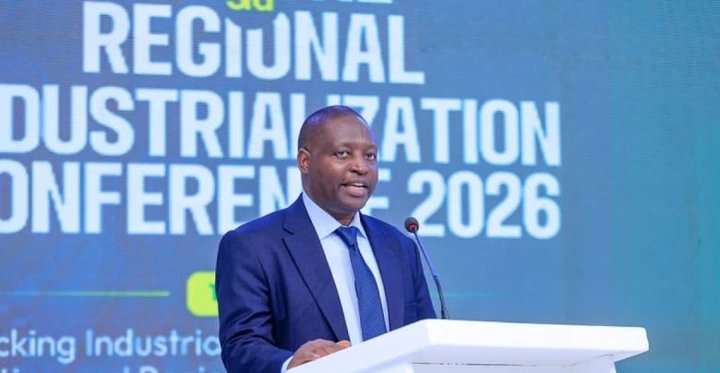

Minister Bahati addressing the 3rd Industrialisation Conference 2026 in Kampala this week
KAMPALA — State Minister for Industry David Bahati has urged East African countries to accelerate industrialisation and value addition, saying Africa’s huge import bill presents an opportunity to build local manufacturing capacity and create jobs.
Speaking earlier this week at the 3rd Annual Regional Industrialization Conference in Kampala, Bahati said Africa possesses about 30% of the world’s mineral reserves, which he valued at $29.5 trillion, but continues to spend more than $650 billion annually importing finished goods.
He said the imbalance showed the continent was exporting raw materials and importing back higher-value finished products instead of building industries around its natural resources.
Bahati also pointed to Africa’s food and petroleum import bills as areas where greater domestic and regional production could have a major economic impact.
According to figures he cited, Africa spends about $97 billion annually importing food despite holding about 65% of the world’s uncultivated arable land, while refined petroleum imports cost the continent as much as $100 billion a year.
The minister said East Africa alone represents a sizeable market capable of supporting large-scale manufacturing.
He placed the East African Community market at about 331 million people, with a combined GDP of approximately $357 billion and merchandise imports worth about $76.4 billion.
“This is a great opportunity,” Bahati said, arguing that regional manufacturers should increasingly target products currently sourced from outside the bloc.
He called for harmonisation of standards, removal of non-tariff barriers and development of cross-border production networks to allow industries in different EAC countries to participate in common value chains.
His remarks echoed concerns raised at the same conference by Uganda’s Commissioner for External Trade, Cleopas Ndorere, who warned that protectionist policies among member states were undermining the EAC Customs Union.
“We still have gaps in implementing EAC policies on tariff and non-tariff barriers. National protectionism undermines regional value chains and the Customs Union,” Ndorere said.
“There is a need to strengthen enforcement and deepen regional integration.”
Trade and Industry Minister Sanjay Tanna has similarly argued that East Africa’s growing consumer market could become a major driver of industrial transformation if governments tackle high production costs, limited industrial finance and barriers to cross-border trade.
Uganda is seeking to position manufacturing and value addition at the centre of its economic transformation agenda, with the government increasingly pushing for domestic processing of agricultural produce and minerals rather than exporting them in raw form.
Bahati said deeper regional integration could help East African industries achieve the scale needed to compete globally while reducing the region’s dependence on imported finished products.


 Starlink goes live in Uganda; price comparisons against MTN, Airtel
Ultimate Uganda
Starlink goes live in Uganda; price comparisons against MTN, Airtel
Ultimate Uganda
 NSSF sets September 24 for Annual Members Meeting as savers await interest rate declaration
Ultimate Uganda
NSSF sets September 24 for Annual Members Meeting as savers await interest rate declaration
Ultimate Uganda
 Boda boda riders launch e-commerce, digital loans platform
Ultimate Uganda
Boda boda riders launch e-commerce, digital loans platform
Ultimate Uganda
 Rwanda: We Cannot Sit and Watch As Illicit Alcohol Kills People - Kagame
Ultimate Uganda
Rwanda: We Cannot Sit and Watch As Illicit Alcohol Kills People - Kagame
Ultimate Uganda
0 Comments