
Debt Repayment, Wages Take Lion’s Share of Q3 Expenditure
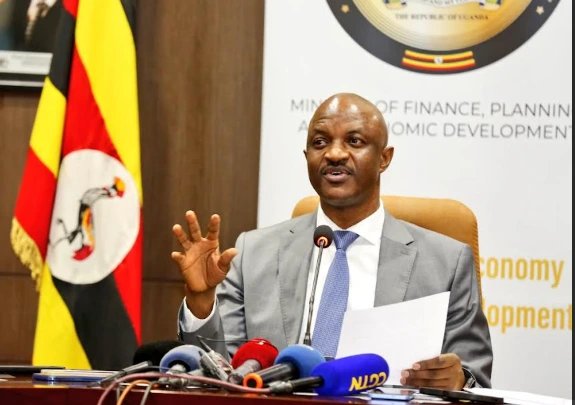

Ramadan Ggoobi speaking to reporters in Kampala on Friday.
The Ministry of Finance has released Shs 16.537 trillion for expenditure in the third quarter of the 2025/26 financial year, with debt repayment and treasury operations taking the largest share.
Out of the total release, Shs 7.59 trillion has been allocated to debt servicing and treasury operations, accounting for nearly half of the entire budget for the quarter—an indication, experts say, of the growing burden of public debt on Uganda’s finances.
Wages and salaries across government will consume Shs 2.175 trillion, while Shs 2.898 trillion has been earmarked for non-wage recurrent expenditure.
Funding Uganda’s Tenfold Growth Strategy
The release comes as government continues to implement its ambitious plan to expand Uganda’s Gross Domestic Product (GDP) tenfold—from USD 50 billion in FY 2023/24 to USD 500 billion within a decade, beginning FY 2024/25.
The strategy is anchored on four key growth drivers: agro-industrialization, tourism development, mineral-based industrialization including oil and gas, and science, technology and innovation—collectively known as ATMS.
According to the Ministry of Finance Permanent Secretary and Secretary to the Treasury, Ramadhan Ggoobi, agro-industrialization will receive Shs 167 billion, targeting agro-industrial research, innovations, and the fast-tracking of the anti-tick vaccine rollout, among other interventions.
Tourism development has been allocated Shs 32.8 billion for promotion initiatives, including the “Explore Uganda†campaign and development of the Uganda Martyrs’ Shrine in Namugongo.
Header advertisement
Mineral-based industrialization, including oil and gas, will take Shs 469.69 billion to accelerate activities aimed at achieving first oil.
Science, technology and innovation—including ICT and the creative industries—will receive Shs 166.15 billion, mainly for expanding internet connectivity and digitizing the economy.
Security and Infrastructure Prioritized
Ggoobi said the ATMS pillars will be supported by what he termed “key enablers,†with security taking the top spot.
The Ministry of Defence and Veteran Affairs received Shs 270.05 billion, Uganda Police Force Shs 42.12 billion, Uganda Prisons Service Shs 73.04 billion, State House Shs 17.92 billion, Office of the President Shs 45.68 billion, Internal Security Organisation (ISO) Shs 42.92 billion, and External Security Organisation (ESO) Shs 18.39 billion.
Infrastructure follows closely, with the Ministry of Works and Transport receiving Shs 1.34 trillion—Shs 111.21 billion from government and Shs 1.23 trillion from external financing. This includes funding for Uganda Airlines, Uganda Railways, Kalangala Infrastructure Services, and the Standard Gauge Railway.
The Ministry of Energy and Mineral Development has been allocated Shs 468.48 billion, largely from external financing, to support rural electrification, transmission lines, and power generation projects.
Health, Education and Local Governments
For human capital development, the Ministry of Health received Shs 344.67 billion, while the National Medical Stores was allocated Shs 245.52 billion for procurement of essential medicines, including addressing gaps created by the withdrawal of USAID support.
The Uganda Cancer Institute and Uganda Heart Institute jointly received Shs 77.37 billion, while national and regional referral hospitals were allocated Shs 39.05 billion.
The Ministry of Education and Sports received Shs 115.5 billion, public universities Shs 107.45 billion, and the National Council of Sports Shs 24.68 billion.
Kampala Capital City Authority (KCCA) was allocated Shs 99.53 billion for service delivery and infrastructure development.
Local governments received Shs 519.87 billion, of which Shs 328.58 billion will go toward conditional and unconditional grants, and Shs 191.28 billion toward capital development.
Call for Faster Implementation
Ggoobi urged all accounting officers to prioritize and fast-track the implementation of government programmes.
“This is to ensure that we sustain momentum for the realization of the development results envisaged under the tenfold growth strategy, especially those targeting wealth and job creation,†he said.
He added that government will continue safeguarding macroeconomic stability by aligning spending with available financing while maintaining consistency with the approved fiscal framework.


 Government will not gazette Kijanangoma as King of Tooro for now - Attorney General insists
Ultimate Uganda
Government will not gazette Kijanangoma as King of Tooro for now - Attorney General insists
Ultimate Uganda
 King Oyo’s Body to Arrive Thursday
Ultimate Uganda
King Oyo’s Body to Arrive Thursday
Ultimate Uganda
 Besigye, Lukwago expected to meet Gen. Salim Saleh today at Kapeeke
Ultimate Uganda
Besigye, Lukwago expected to meet Gen. Salim Saleh today at Kapeeke
Ultimate Uganda
 Rwabwogo Advised to ‘Eat His Bishop’ As MK Prepares to Enter State H’se: PREZ MUSEVENI ON HIS WAY OUT
Ultimate Uganda
Rwabwogo Advised to ‘Eat His Bishop’ As MK Prepares to Enter State H’se: PREZ MUSEVENI ON HIS WAY OUT
Ultimate Uganda
0 Comments