
INCOMPETENCE OR SABOTAGE? Sh53bn Karamoja Valley Dams, Tanks Turn into Mud Pits Under Ministry of Water Negligence
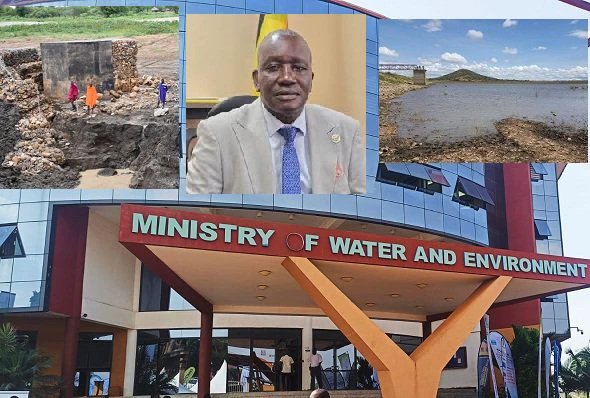

A shocking Auditor General’s report has exposed deep rot, negligence and sheer incompetence at the Ministry of Water and Environment, after billions of shillings meant to save Karamoja from chronic water shortages were blown on valley tanks and dams that are now choked with silt, broken down or completely useless.
According to the report, the Ministry of Water and Environment, working with the Office of the Prime Minister, constructed 106 valley tanks at a cost of UGX 8.7 billion and five dams worth UGX 45 billion across nine districts in Karamoja to support livestock, irrigation and domestic water use. But years after commissioning, the same projects are collapsing under poor maintenance, weak supervision and total abandonment by the ministry.
“The infrastructure was handed over to communities through Water User Committees responsible for operation, management and maintenance,†the Auditor General notes. But the report adds that this handover was largely cosmetic, leaving communities with massive structures and no capacity to manage them.
During the year under review, the Ministry of Water and Environment received UGX 1 billion for maintenance of 10 valley tanks and UGX 100 million for rehabilitation of three dams. However, when auditors physically inspected the facilities in November 2025, they found a disaster.
Out of 25 valley tanks inspected, 18 were heavily silted, while the remaining seven were struggling with “eroded water inlets, weed invasion, unprotected water sources, damaged animal drinking troughs, dilapidated cattle access ramps and eroded embankments.†The Auditor General bluntly states that 72 percent of the valley tanks are in a sorry state, rendering them incapable of holding adequate water.
On dams, the picture was equally worrying. While three were described as “well maintained,†one dam had “overgrown grass and damaged animal drinking troughs,†and another at Kawomeri was completely non-functional due to lack of water.†The cause, the report says, was “encroachment of the catchment area,†a failure squarely blamed on poor planning and lack of enforcement by the ministry.
The report warns that because of the heavy silting, “the valley tanks and dams have suffered reduced water storage capacity, resulting in limited water availability for livestock and agriculture.†For a region that depends almost entirely on livestock, this failure is catastrophic.
The Auditor General directly points an accusing finger at the Ministry of Water and Environment, citing “absence of clear maintenance plans, unclear roles between Local Governments and the Ministry, limited community ownership, inadequate practical training of Water User Committees and unprotected catchment areas.†The situation has been worsened by “overgrazing due to high livestock numbers, particularly affecting valley tanks,†a known risk the ministry failed to plan for.
In a stinging rebuke, the Auditor General advised the ministry’s Accounting Officer to “establish clear maintenance plans and budgets for all the 106 valley tanks and five dams,†clarify responsibilities, protect water sources through reforestation and provide communities with “practical training in operation, maintenance, basic repair skills and water source protection techniques.â€
But for many in Karamoja, the damage is already done. Billions have been spent, water sources are failing, and communities are once again staring at dry seasons with empty dams and mud-filled valley tanks.
As the Auditor General’s report lays bare, Karamoja’s water crisis is no longer about climate change or drought alone. It is about failure at the centre. It is about a Ministry of Water that built projects, pocketed praise, and walked away, leaving behind rusting infrastructure, thirsty livestock and a region betrayed.
So who pays the price?
Insiders point fingers at the very top. Dr. Alfred Okot Okidi, the Permanent Secretary at the Ministry of Water and Environment, is quietly taking heat for what critics describe as glaring oversight failures. Sources allege the accounting officer has spent long stretches away on trips abroad-some medical related-effectively running the ministry from airport lounges and in the skies, while key responsibilities are normally delegated to Eng. John Mary Vianne Twinomujuni, the Commissioner for Urban Water Supply and Sewerage Services — a role critics say does not equip him with sufficient experience to supervise complex rural water systems in fragile regions like Karamoja.
The result? Projects left to rot, contractors unchecked, and communities abandoned.
With anger rising among the Karamoja community and the Auditor General’s findings now in the open, all eyes are on the powers that be. Will President Museveni crack the whip, or will Karamoja once again be left to swallow promises — and dust?
More details to follow in our subsequent publication regarding the rot at the Water Ministry!


 Government will not gazette Kijanangoma as King of Tooro for now - Attorney General insists
Ultimate Uganda
Government will not gazette Kijanangoma as King of Tooro for now - Attorney General insists
Ultimate Uganda
 King Oyo’s Body to Arrive Thursday
Ultimate Uganda
King Oyo’s Body to Arrive Thursday
Ultimate Uganda
 Besigye, Lukwago expected to meet Gen. Salim Saleh today at Kapeeke
Ultimate Uganda
Besigye, Lukwago expected to meet Gen. Salim Saleh today at Kapeeke
Ultimate Uganda
 Rwabwogo Advised to ‘Eat His Bishop’ As MK Prepares to Enter State H’se: PREZ MUSEVENI ON HIS WAY OUT
Ultimate Uganda
Rwabwogo Advised to ‘Eat His Bishop’ As MK Prepares to Enter State H’se: PREZ MUSEVENI ON HIS WAY OUT
Ultimate Uganda
0 Comments