
Chilling final words of astronauts who burnt alive during launch rehearsal
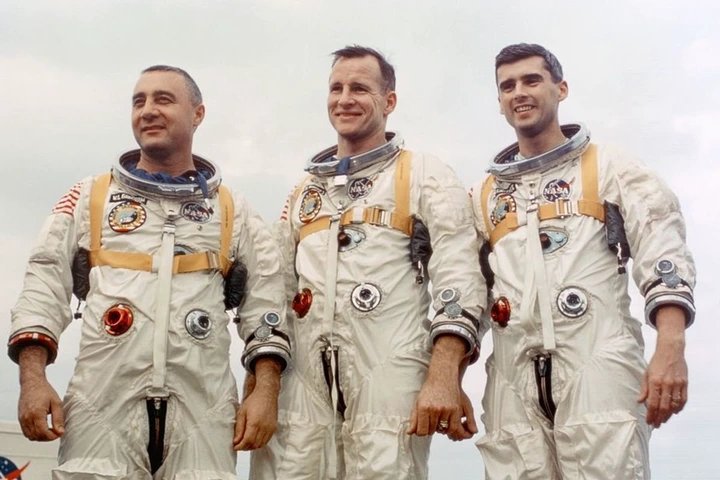

Virgil I. 'Gus' Grissom, Edward H. White, and Roger B. Chaffee all lost their lives when flames and carbon monoxide consumed the cabin of their spacecraft during a launch rehearsal test
The crew of the Apollo 1 space mission: Command Pilot Virgil I. Grissom, Senior Pilot Edward Higgins White II and Pilot Roger B. Chaffee (from left to right)
The crew of the Apollo 1 space mission: Command Pilot Virgil I. Grissom, Senior Pilot Edward Higgins White II and Pilot Roger B. Chaffee (from left to right)(Image: Getty Images)
The exploration of space took a leap forward this week with the successful launch of Nasa's Artemis II. Its mission will see four astronauts travel more than half a million miles around the moon, with the aim of a better understanding of the lunar environment. It's also expected to result in a moon landing, and ultimately pave the way for a moon 'base'.
It's been more than 50 years since humans last landed on the moon with astronauts Eugene Carnan and Harrison Schmitt spending over three days on the lunar surface as part of NASA's Apollo 17 mission in December 1972.
There have been six crewed Moon landings; Apollo 11 was the first in July 1969, and Apollo 17 was the final mission. But lives have been lost along the way.
READ MORE : Artemis 2 astronauts hit with 'loss of comms' just 51 minutes into Moon launch READ MORE : Artemis 2 launch successful as first lunar mission in 53 years kicks off
From left, Apollo 1 astronauts Gus Grissom, Ed White and Roger Chaffee pose in front of their Saturn 1 launch vehicle at Launch Complex 34 at the Kennedy Space Centre
From left, Apollo 1 astronauts Gus Grissom, Ed White and Roger Chaffee pose in front of their Saturn 1 launch vehicle at Launch Complex 34 at the Kennedy Space Centre(Image: SSPL via Getty Images)
Three astronauts horrifically lost their lives during the NASA Apollo 1 space mission, burning to death when flames engulfed the cockpit during a launch rehearsal. The loss of Virgil I. 'Gus' Grissom, Edward H. White, and Roger B. Chaffee stands as one of the space race's most notorious disasters.
The trio were taking part in a pre-test flight on January 27, 1967 at Cape Kennedy Air Force Station Launch Complex 34. They were preparing for what was meant to be the first crewed Apollo mission. But a cabin fire broke out, killing all three crew members.
While preparing for the mission, the crew voiced apprehensions about the compact spacecraft. Their concerns centered on the quantity of flammable nylon materials within the cabin.
Virgil I Grissom, Edward White and Roger Chaffee inside a practice module for the aborted Apollo 1 mission at Cape Kennedy, Florida
All three men were killed when a fire swept through the oxygenated Command Module during a pre-flight test on 27th January, 1967(Image: Getty Images)
Gus Grissom was the first to enter, and he hooked up to his oxygen supply from the spacecraft. He described a "sour smell" in the spacesuit loop; the crew stopped to take a sample of the suit loop, and after discussion decided to continue the test. There were also concerns about an alert signalling excessive oxygen flow in the cabin.
Another major issue was with communication. At first, faulty communications seemed to exist solely between Commander Grissom and the control room. But radio contact with ground personnel and mission control also proved challenging due to persistent static interference.
The crew made adjustments, and by 6:31 the test conductors were about ready to pick up the count when ground instruments showed an unexplained rise in the oxygen flow into the spacesuits.
Command Module of the Apollo 1 spacecraft after a fire killed three astronauts
The fire erupted in the Command Module of the Apollo 1 spacecraft(Image: Corbis/VCG via Getty Images)
According to the National Air and Space Museum, "four seconds later, an astronaut, probably Chaffee, announced almost casually over the intercom: 'Fire, I smell fire'. Two seconds later, Astronaut White's voice was more insistent: 'Fire in the cockpit'."
Flames broke out inside the confined spacecraft before anyone could respond. The emergency exit protocol required a minimum of 90 seconds, but it took less than 30 seconds for the fire and lethal fumes to consume the cabin.
The autopsy report determined that the primary cause of death for all three astronauts was cardiac arrest caused by high concentrations of carbon monoxide. Grissom was reported to have suffered severe third-degree burns on more than one-third of his body with his spacesuit almost completely destroyed.
Edward H White II, Virgil I 'Gus' Grissom and Roger B Chaffee
Edward H White II, Virgil I 'Gus' Grissom and Roger B Chaffee. Gus spoke about the dangers of space exploration before his death(Image: Getty Images)
White suffered third-degree burns on almost half of his body and a quarter of his spacesuit had melted away. Chaffee suffered third-degree burns on almost a quarter of his body and a small portion of his spacesuit was damaged. It was concluded that most of the burns had occurred postmortem.
Two years before his death, Grissom had acknowledged the dangers of space missions, saying: "If we die, we want people to accept it. We are in a risky business and we hope that if anything happens to us it will not delay the program. The conquest of space is worth the risk of life."


 DRC opposition urges Tshisekedi to abandon constitutional changes
Ultimate Uganda
DRC opposition urges Tshisekedi to abandon constitutional changes
Ultimate Uganda
 US military transport plane lands in Moscow
Ultimate Uganda
US military transport plane lands in Moscow
Ultimate Uganda
 Putin puppet slaps UK with terrifying 2-word warning over drone factories
Ultimate Uganda
Putin puppet slaps UK with terrifying 2-word warning over drone factories
Ultimate Uganda
 China develops hypersonic weapon to hunt US command aircraft thousands of miles away
Ultimate Uganda
China develops hypersonic weapon to hunt US command aircraft thousands of miles away
Ultimate Uganda
0 Comments