
Gen Kayanja Marks 45 Years Since Joining NRA Bush War
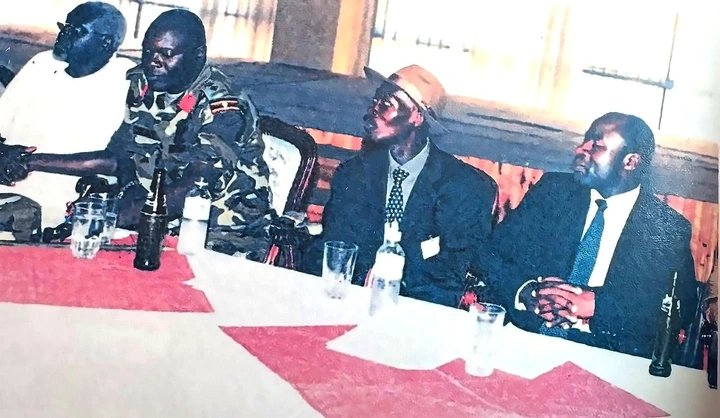

General Kayanja (second from left) pictured with members of his Operation Wembley team in the early 2000s. The unit was known for its tough and uncompromising approach in tackling crime in Kampala and other urban areas across the country.
A former Operation Wembley commander, Maj Gen Elly Kayanja is being commemorated for a 45-year journey from a young guerrilla recruit in the bush war to a key figure in military and intelligence establishment.
Forty-five years ago, 21-year-old Elly Kayanja (RO 167) set foot on the frontlines of the National Resistance Army bush war—a five-year guerrilla conflict that would go on to define Uganda's military and political trajectory.
Born on November 23, 1959, in Kifamba Village, Kakuuto County in present-day Rakai District, Elly Kayanja Kiiza Kakande was the ninth of 27 children of the late Ssalongo Festo Kayanja and Nnalongo Leocadia Najjemba Kayanja.
He attended Kifamba Primary School (1968–1976) and Ssese Farm School in Kalangala District (1977–1979).
In his book, The Journey to Remember (2025), Kayanja recounts how his ambitions shifted from education to work after farm school, prompting him to move to Kampala, where he lived with his elder sister Christine Nakayanja before working as a farmer on the farm of the late Wassaka Musoke.
It was during this period that he became politically active.
Motivated by what he describes as a reformist agenda led by Yoweri Museveni, Kayanja joined the Uganda Patriotic Movement to oppose the government of Milton Obote, which he associated with repression and political violence, including the 1966 attack on Edward Muteesa II.
Following the disputed 1980 elections, UPM leaders rejected the results and retreated to the bush to launch an armed struggle.
Kayanja initially remained behind to mobilise and gather intelligence before officially joining the war on April 11, 1981.
In the bush, he quickly assumed high-risk roles, including intelligence gathering, logistics, and operational guidance.
His first combat experience—an attack on a stalled government tank near Matugga—left a lasting impression as he fired his first shot under intense pressure.
Kayanja later became part of the feared “Black Bomber†unit under Matayo Kyaligonza, which carried out operations targeting key economic and military installations around Kampala.
After undergoing cadre training in Kijaguzo, Luweero, he rose through the ranks from Sergeant to Provisional JOII (1982) and JOI (1983), participating in major battles including Kabamba II (1983), Masindi and Hoima (1984), Kabamba III (1985), Kembogo (1985), Katonga (1985), and the eventual capture of Kampala in 1986.
Following the NRA’s victory and Museveni’s rise to power on January 26, 1986, Kayanja was appointed Director of Welfare.
In 1997, then Lt Col Kayanja became Commander of the Mubende Casualty Unit, later renamed the Mubende Rehabilitation Centre, where he served until 2001.
During this period, he initiated livelihood programs such as the Children and Wives of Disabled Soldiers Association (CAWODISA) market to support injured soldiers and their families.
In 2002, he was appointed Deputy Director General of the Internal Security Organisation under Henry Tumukunde, before rising to Director General in 2003. The same year, he also served as Army Member of Parliament.
Kayanja gained national prominence as Commander of Operation Wembley, a controversial military-led crackdown on armed crime in Kampala.
The operation is credited by supporters with dismantling organised criminal networks, though it drew criticism over extrajudicial actions and lack of due process.
He later served as Deputy Coordinator of National Intelligence under David Sejusa, also known as Tinyefuza. He was promoted to Brigadier General in 2006 and to Major General in 2021 before retiring in May 2022.
Beyond the military, Kayanja is engaged in farming and maintains close family ties as a husband, father, and grandfather.
His post-retirement years have not been without controversy. In July 2025, he criticised the National Resistance Movement primaries in Rakai after his sister Asha Lubyayi Kayanja lost to incumbent Juliet Kinyamatama.
The result was upheld by the party tribunal, and Lubyayi later ran as an independent candidate but was unsuccessful.
Despite the scrutiny, Kayanja remains a prominent and respected figure within Uganda’s security and political circles.
In the foreword to his recent publication, Internal Affairs Minister Kahinda Otafiire described him as a “skilled soldier with a chain of undisputed civil-military accomplishments.â€
As his personal motto states: “You are free to advise me, but the final decision is mine.â€


 Government will not gazette Kijanangoma as King of Tooro for now - Attorney General insists
Ultimate Uganda
Government will not gazette Kijanangoma as King of Tooro for now - Attorney General insists
Ultimate Uganda
 King Oyo’s Body to Arrive Thursday
Ultimate Uganda
King Oyo’s Body to Arrive Thursday
Ultimate Uganda
 Besigye, Lukwago expected to meet Gen. Salim Saleh today at Kapeeke
Ultimate Uganda
Besigye, Lukwago expected to meet Gen. Salim Saleh today at Kapeeke
Ultimate Uganda
 Rwabwogo Advised to ‘Eat His Bishop’ As MK Prepares to Enter State H’se: PREZ MUSEVENI ON HIS WAY OUT
Ultimate Uganda
Rwabwogo Advised to ‘Eat His Bishop’ As MK Prepares to Enter State H’se: PREZ MUSEVENI ON HIS WAY OUT
Ultimate Uganda
0 Comments