
Govt bans nine hazardous agrochemicals to safeguard health, export markets
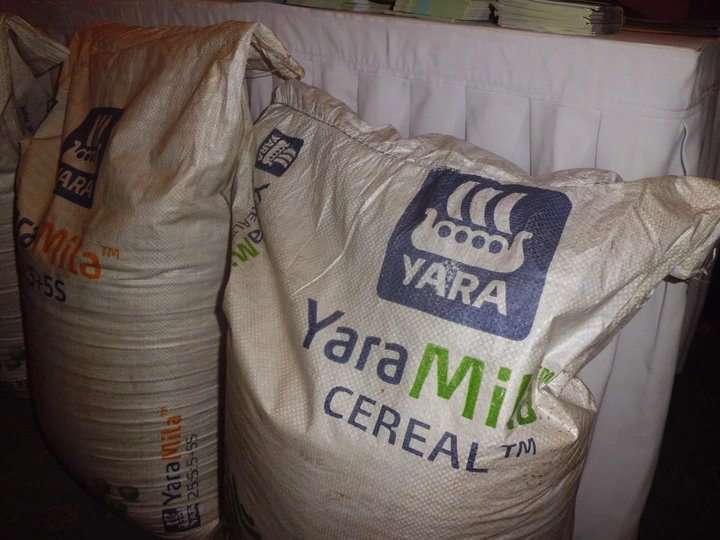

Yara fertilizer which farmers are advised to use moderately following the required instruction to avoid challenges caused to the environment. Photo/ Lominda Afedraru
In a sweeping regulatory move aimed at safeguarding public health, environmental integrity, and international trade, the Ministry of Agriculture, Animal Industry and Fisheries (MAAIF) has banned the use of nine widely used agrochemical active ingredients. The ministry has also placed another nine chemicals under strict restriction.
The decision, which took effect in April, was triggered by emerging international scientific evidence and growing trade concerns regarding the potential risks these active ingredients pose to human health, food systems, and compliance with global chemical residue standards.
The revelations were made during the second annual Crop Life Uganda Symposium held recently in Kampala. The high-level dialogue brought together agricultural experts, input dealers, and regulators to address pressing challenges in the sector, specifically food safety and the escalating health hazards caused by the improper or excessive use of agrochemicals.
Experts at the symposium warned that the misuse of these substances has led to dangerously elevated chemical residues in everyday food products, such as vegetables and milk, threatening the lives of Ugandan consumers and jeopardizing the country’s agricultural export market.
Speaking at the symposium, Dr Paul Mwambu, the Commissioner for Crop Inspection and Certification at MAAIF, explained that the regulatory overhaul followed a request by industry association Crop Life Uganda. The association urged the ministry to review 18 specific agrochemicals due to safety concerns surrounding their ingredients.
"Our ministry experts subjected these chemicals to rigorous scientific laboratory tests," Dr Mwambu explained. "Following a technical review by the Agricultural Chemicals Control Technical Committee and final consideration by the Agricultural Chemicals Review Committee, the government reached a definitive decision to phase out nine active ingredients completely."
Dr. Mwambu emphasized that the move is part of the government’s statutory obligation to ensure that only safe, effective, and internationally acceptable agricultural chemical products remain in circulation.
The nine banned active ingredients, previously found in various pesticides and herbicides across Ugandan farms, have been blacklisted due to their severe toxicity to humans and the ecosystem:
• Alpha-cypermethrin & Chlorothalonil: Identified as severe water pollutants that destroy aquatic life and kill beneficial insects, including bees.
• Atrazine, Butachlor & Carbofuran: Proven to contaminate underground water systems. Atrazine exposure is linked to reduced male fertility, comas, circulatory collapse, and gastric bleeding, while Carbofuran causes severe skin and eye irritation and is highly toxic to local flora and fauna.
• Dichlorvos & Dimethoate: Dichlorvos is acutely toxic to the environment. Dimethoate has been found to cause reproductive disorders in humans and is lethal to essential pollinators.
• Diuron & Propanil: Chronic exposure to these chemicals is directly linked to kidney failure, spleen damage, and liver damage in humans.
Dr. Mwambu reassured farmers that viable, safer alternatives are already available on the market to replace these nine banned substances.
In addition to the outright bans, the ministry has placed nine other active ingredients under tight restrictions, limiting their application to specific crops or structural uses:
• Ametryn: Restricted exclusively for weeding in sugarcane and pineapple plantations.
• Carbendazim: Approved for use on cashew nuts only.
• Chlorpyrifos & Fipronil: Chlorpyrifos is restricted strictly to treating anthills, while Fipronil is confined to controlling termites at construction sites.
• Imidacloprid: Restricted solely to registered seed companies for professional seed treatment.
• Indoxacarb: Approved only for tomato farmers to combat devastating pests like Tuta absoluta and the diamondback moth.
• Profenofos & Thiamethoxam: Profenofos is limited to controlling the Fall Armyworm. Thiamethoxam is restricted to managing the black coffee twig borer in coffee and the Fall Armyworm in maize.
A unique exception was made for Mancozeb, a widely used fungicide critical for managing fungal diseases in potatoes, tomatoes, and various fruits.
"There is currently no viable alternative for Mancozeb on the market," Dr. Mwambu revealed. "Because it is so critical to our food supply chains, the ministry is retaining it for the next five years while safe alternatives are urgently being sought."
The government has issued a strict 180-day farm-use cessation deadline. Farmers across the country are required to immediately discontinue the field application of all phased-out products and transition to approved, safer alternatives.
For the chemicals placed under restriction, the ministry announced that they will remain under tightly controlled conditions. This includes revised product labels, the strict enforcement of Pre-Harvest Intervals (PHIs) to ensure chemicals degrade before crops are harvested, and rigorous residue stewardship monitoring.
To enforce these new regulations, MAAIF is strengthening its nationwide surveillance, compliance inspections, market intelligence, and post-registration stewardship controls across the entire agricultural value chain.
Ms Agnes Mbabazi, the Chairperson of Crop Life Uganda, emphasized that while her organization advocates for the use of agro-inputs to maximize crop yields, productivity must not come at the expense of human health or the environment.
She noted that Crop Life Uganda is working hand-in-hand with MAAIF to build the capacity of input dealers and farmers to adopt responsible crop protection practices.
"It is vital for farmers to observe best practices," Ms. Mbabazi said. "This means ensuring they buy inputs only from genuine, licensed dealers, and meticulously reading usage labels to avoid crop damage and soil degradation."
Ms. Mbabazi also called on agro-chemical importers to cooperate with regulators to prevent the importation of hazardous or counterfeit chemicals that could jeopardize Ugandan agriculture.
Dr. Mwambu echoed her sentiments, stating that regulatory compliance cannot be achieved by the government alone.
"Protecting our farmers, consumers, and export market access is a shared responsibility among manufacturers, distributors, agro-input dealers, and farmers," Dr. Mwambu concluded. "We call upon all private sector actors to engage transparently with the Designated National Authority to ensure a clean, safe, and sustainable agricultural sector."


 Starlink goes live in Uganda; price comparisons against MTN, Airtel
Ultimate Uganda
Starlink goes live in Uganda; price comparisons against MTN, Airtel
Ultimate Uganda
 NSSF sets September 24 for Annual Members Meeting as savers await interest rate declaration
Ultimate Uganda
NSSF sets September 24 for Annual Members Meeting as savers await interest rate declaration
Ultimate Uganda
 Boda boda riders launch e-commerce, digital loans platform
Ultimate Uganda
Boda boda riders launch e-commerce, digital loans platform
Ultimate Uganda
 Rwanda: We Cannot Sit and Watch As Illicit Alcohol Kills People - Kagame
Ultimate Uganda
Rwanda: We Cannot Sit and Watch As Illicit Alcohol Kills People - Kagame
Ultimate Uganda
0 Comments