
Uganda unfazed by Kuwait labour ban as Middle East remittances hit Shs3 trillion
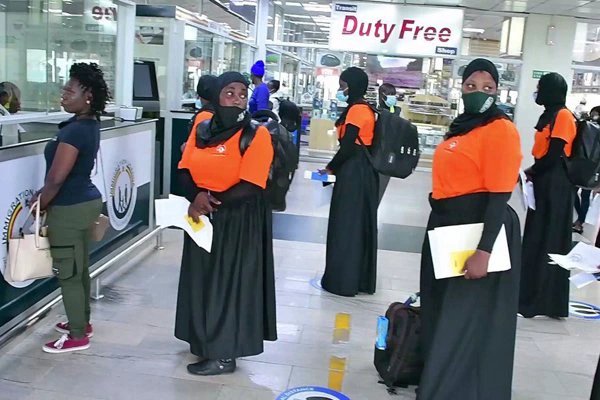

The Government of Uganda has downplayed a decision by the State of Kuwait to ban the recruitment of domestic workers from Uganda and 26 other nations, stating that the country has no formal bilateral ties with the Gulf state.
Kuwait’s Ministry of Interior recently announced a sweeping overhaul to regulate its domestic labour sector, restricting recruitment to just 10 approved nations, including South Africa, Ethiopia, the Philippines, India, and Sri Lanka. Meanwhile, Uganda, Kenya, Rwanda, Burundi, and Nigeria are among the 27 countries slapped with a total ban following recommendations from Kuwait's ministries of foreign affairs and health.
Reacting to the developments, Mr Aggrey Kibenge, the Permanent Secretary of Uganda's Ministry of Gender, Labour, and Social Development, clarified that the ban does not impact official externalisation programmes.
"Our policy is that we only clear domestic workers to countries where we have bilateral labour agreements. Since we don't have any agreement with Kuwait, we are not affected. Those who go there must be going on their own," Mr. Kibenge explained.
While official channels bypass Kuwait, historical data indicates that over 700 Ugandans have previously traveled independently to the Gulf state for employment. The new restrictions underscore the vulnerabilities faced by Ugandans who bypass formal frameworks. Currently, Uganda maintains active bilateral labour agreements with other Middle Eastern and United Arab Emirates (UAE) destinations, including Saudi Arabia, Jordan, Qatar, and the UAE (Dubai).
The Middle East remains a crucial economic lifeline for Uganda, absorbing over 270,000 Ugandan workers over the last decade, primarily in the care and hospitality sectors.
According to data from the Ministry of Gender, Ugandan migrant workers in the Middle East send home approximately $822 million annually (nearly Shs3.1 trillion), accounting for roughly 33 per cent of Uganda’s total inward remittances. Saudi Arabia alone contributes about $350 million to this total, with women making up an estimated 84 per cent of that specific care workforce.
The broader impact of the diaspora was highlighted by the Minister of Finance, Planning, and Economic Development, Mr Henry Musasizi, during his June 11, 2026, budget speech for the financial year 2026/2027. He noted that total global remittances from Ugandans working abroad significantly increased to $2.8 billion in the twelve months to March 2026, up from $1.9 billion the previous year.
Despite these massive economic injections, the labour externalisation industry continues to face high-level political resistance. The Kuwait ban comes on the heels of sharp criticism from President Yoweri Museveni regarding the high number of Ugandans seeking "greener pastures" in Gulf nations.
"You find people going to work in Dubai. What are you going to do in Dubai? A desert? You leave paradise here [in Uganda] and you go to work in those places. It is inferiority complex, ignorance, poor leadership," President Museveni stated during his State of the Nation Address on June 4, 2026.
Despite presidential reservations, externalised labour remains a vital valve for releasing unemployment pressure, providing essential foreign exchange, investment capital, and household income for thousands of Ugandan families.


 DRC opposition urges Tshisekedi to abandon constitutional changes
Ultimate Uganda
DRC opposition urges Tshisekedi to abandon constitutional changes
Ultimate Uganda
 US military transport plane lands in Moscow
Ultimate Uganda
US military transport plane lands in Moscow
Ultimate Uganda
 Putin puppet slaps UK with terrifying 2-word warning over drone factories
Ultimate Uganda
Putin puppet slaps UK with terrifying 2-word warning over drone factories
Ultimate Uganda
 China develops hypersonic weapon to hunt US command aircraft thousands of miles away
Ultimate Uganda
China develops hypersonic weapon to hunt US command aircraft thousands of miles away
Ultimate Uganda
0 Comments