
Mbarara airport dream runs into viability headwinds

public speeches, President Museveni likes using statistics to persuade and sway even sceptics about the economic dividends of accelerated investments in infrastructure. Whether it is railways, roads or hydro-dams, Mr Museveni specifies an expected drop in haulage costs, the internal rate of return per every kilometre of paved thoroughfare, and/or per-capita kilowatt consumption symbolising development. That has portrayed him as a fastidious leader. However, in February 2026, he sprang a surprise by directing Prime Minister Robinah Nabbanja to galvanise bureaucrats to aid a Ugandan-Chinese consortium to build an international airport in Mbarara City, despite the absence of a feasibility study.
The Ugandan promoters of the intended Nyakisharara International Airport project, whom the head of State met in September 2025 and again in February this year, are Base 7 Aviation International Academy, currently domiciled at the aerodrome, and Hamster Business Solutions, the consultant. Three other firms have been onboarded: China Southwest Architectural Design and Research Institute, to conduct the feasibility study and provide architectural designs; Hunan Construction and Investment Engineering Company, designated to carry out the engineering works; and Blackrock Uwekeza, the earmarked financer.
Without a feasibility study, there is no verdict on whether the planned project is implementable or viable. There is not much information about it other than the President’s revelation that it will have two 5.5-kilometre runways and a 3.5-kilometre runway exclusive for Very Important Persons (VIP), making it rival some of the largest airports in the world. The cost of building the international airport has not been disclosed; there are no projected passenger numbers and cargo volumes, and the establishment of the facility is not provisioned in Uganda’s fifth national blueprint, the National Development Plan (NDP IV). In addition, there is no explanation, at least publicly, why Nyakisharara is not being developed incrementally, as has been the case with Entebbe International Airport, and no pointers to advantages it has over other airports within the country and region.
Aviation consultant Sean Mendis of Malawi said countries like Ethiopia did not become international aviation hubs overnight. They developed over decades, he said, supported by national carriers and consistent demand. Uganda, by contrast, has struggled repeatedly to sustain a viable national airline and is now ramping up the construction of international airports without defined demand. For instance, the Kabalega International Airport in Hoima, pegged to the nascent oil industry, is nearly complete, and President Museveni early this month launched the construction of Kidepo International Airport in Karamoja, bankrolled by Emirati investors, to boost tourism and commerce.
On June 18, the African Development Bank approved Euros 156m (Shs650b) for upgrading Arua airfield in northwestern Uganda, the second busiest aerodrome in the country, to an international airport to mainly promote international trade. In the southwestern Ntungamo District, the government is setting up another international airport, code-named Coffee International Airport, to boost tourism and trade in agriculture. The rising number of international airports, according to industry insiders, is good news as they provide alternatives to Entebbe, the country’s only international air gateway, saving time and resources for businesses and travellers, but questions remain over business prospects.
As such, aviation experts, among them Mr Mendis, suggest that Uganda should focus on developing regional and domestic aviation markets and building an airport closer to Kampala to supplement Entebbe, whose future expansion is constrained by natural barriers. “Nobody can argue against an airport with a 5-6 million annual capacity located in the Kampala area,†he said in reference to estimated passenger traffic at Entebbe International Airport by 2033 when ongoing expansion is completed.
“A project like that of (Mbarara) at [a grand] scale? No,†he noted. In a briefing to Prime Minister Nabbanja early this year, Mr Eddie Kisitu Sengendo, a shareholder/director in Hamster Business Solutions Limited and consultant for the Nyakisharara project, said: “This facility (planned Nyakisharara airport) is actually aimed at snatching about thirty percent of traffic from the rest of the airports known.†These number roughly 1,200-1,300 in the world, with Uganda, since 1951, having one international airport at Entebbe peninsula, whose annual passenger traffic, according to the Uganda Civil Aviation Authority, has increased to 2.4 million over thirty-four years. For this reason, Mr Mendis told this newspaper that the Nyakisharara International Airport project is a pipe dream, and questioned if it was conceptualised for political rather than economic reasons.
“It’s puzzling,†he noted, adding that “there’s nothing about this misguided infrastructure project that should be taken seriously from an aviation perspectiveâ€. The elevation of the current airfield at Nyakisharara, at 4,600 feet above sea level, would disadvantage the planned airport because aircraft departing would have payload restrictions. “The higher an airport is located, the thinner the air density. This means aircraft cannot lift as much load either in fuel or cargo/passengers than they can at sea level,†he said.
This explanation, which other aviation experts have not challenged, strikes at the heart of the very basis upon which President Museveni and promoters relied to pitch the development of Nyakisharara as game-changing. Nyakisharara, they noted, is positioned by nature as a mid-point between Latin America and Asia, specifically Brazil and China, meaning airlines would save on fuel and time (the President estimated by 14-22 hours) by connecting through western Uganda rather than via Europe.
“However, their [current] route of communication is wholly irrational and uneconomic. It is South America, over the Atlantic, over Europe, Asia, etc to China and back. It takes 34-42 hours,†Mr Museveni noted, adding: “Yet, if someone was to come from Brazil, refuel at Nyakisharara, it would take him 20 hours of flying time.†An aviation expert, who asked not to be named due to the sensitivity of the matter, in an analysis for this newspaper, concluded that transiting from either Brazil or China through western Uganda is a slightly longer distance than connecting via Spain or other European capitals. For instance, a flight from Sao Paulo to Nyakisharara, which is roughly 8,660 kilometres, is estimated at 9-10 hours at a typical 850-900 kilometre-per-hour long-haul cruise, while the 9,700-kilometre Nyakisharara-Peking (Beijing) trip would take 10-11.5 hours, subject to weather and aircraft type.
That’s a 21-hour flying time, adding to refuelling delays or layovers. Conversely, according to the analyst, a trip by plane from Brazil to China, with a stop-over in Madrid, would be 800 kilometres and an hour or so shorter. “The proposed Uganda routing is a detour, not a shortcut,†according to the analysis. It adds:“The claim of current routes taking 32-42 hours is … inflated. Real one-stop flights [between] Brazil [and] China (via Europe, Middle East, or [the] US) are typically 23-27 hours lapsed, with 18-20 hours in the air across two legs.†State House declined to comment on the economic viability of the intended Nyakisharara airport project, which President Museveni directed to be executed, referring our inquiries to line technocrats who were reluctant to speak either.
“At the moment, I do not have verified information on the matters [that] you have raised and would not want to comment before establishing the facts,†said Mr Sandor Walusimbi, the senior presidential spokesman. The suggestion that it possibly takes longer and is more expensive to connect via Nyakisharara than Europe contradicts the salesman’s pitch that the planned new airport would be a more affordable, centrally-located transit, refuelling and cargo hub. Dr Fred Muhumuza, an economist, said the government would require massive investment in utilities, security, healthcare, and connectivity to make the planned airport operational, despite its intended construction under a Build, Operate and Transfer (BOT) arrangement.
Mr Mendis earlier argued that the airport project makes little to no economic sense because no more than 200,000 passengers take a Brazil-China-Brazil flight a year which, by contrast, is less than the number of Ugandan domestic workers exported to the Middle East. Data from the International Air Transport Association, which brings together global airlines, has a more modest estimate of passenger numbers between Brazil and China, with most cargo – predominantly iron ore and soybeans - shipped via the ocean waters.
Mr John Baptist Eidit, an aerospace engineer and lead instructor at Jojam Aviation Academy, told our sister NTV-Uganda television station that Entebbe could have served the same purpose that Nyakisharara is billed to provide. He said that the argument that western Uganda is centrally-located between Asia and South America was primarily “a selling pointâ€. Sources familiar with the aviation industry say regional headwinds marked by inter-state competition await the lift-off of Nyakisharara, if its planned construction develops the wings to fly. For example, Ethiopia, with Africa’s most profitable national carrier, is building a massive airport at Bishoftu to handle 110 million passengers annually.
In neighbouring Kenya, Jomo Kenyatta International Airport, challenged by overcapacity on the back of its KQ wings, is expanding. Rwanda, Uganda’s southwestern neighbour whose flag RwandAir flies, is constructing the $2 billion (Shs7.2 trillion) Bugesera International Airport in partnership with Qatar Airways as a premier transport and logistical hub. Some of these projects are planned to be completed by 2030, the same deadline as for the proposed international airport in Mbarara. By comparison, Uganda is still growing its aviation profile, with Uganda Airlines, the national carrier, struggling to break through since its revival in 2019.
Despite the differing opinions about business prospects, leaders and residents in Mbarara City, as well as tourism sector players, have welcomed the idea of an international airport at Nyakisharara as futuristic and attractive for trade and foreign direct investments. Mr Wilberforce Kagimba, the chairperson of Renteragara Parish in Nyakisharara, said while they welcome the proposed development, locals must be involved in the discussions right from the onset to prevent ongoing speculative land pricing and buying, as well as potential cheating of landlords through property undervaluation. “… those likely to be affected should be officially invited to meetings where government representatives clearly explain the plans,†said Mr Kagimba. “At the moment, we do not know where exactly the airport will be located, how large it will be, or how many people will be affected,†he said.
According to the blueprint, the airport is to cover 21 square kilometres, but there is no point on the ground where the measurement will start or end, leaving neighbours second-guessing if the project will affect them or not. Mr Daniel Arinda, the chief executive officer of Africa Real Estates, based in Mbarara City, said news of the planned airport has resulted in speculative land pricing and buying, with landlords lining their pockets with heavy proceeds. “We were selling plots of 25 decimals at only Shs25 million, but ever since the President announced that there is a big airport coming to western Uganda, specifically in Nyakisharara, now prices have gone up to 45 million per plot of 100-by-100 feet,†he said. Costs of commercial plots have tripled, taking a form similar to 2020 when news of the planned upgrade of Nyakisharara airfield to an international airport first surfaced.
“So, we think the coming of the airport is an influence because the change has just happened instantly,†added Mr Arinda. Other residents told this newspaper that the hitherto unappealing hinterland, notably along Kyamugorani-Bwizibweera-Makoonje-Kaigoshoora stretch where the Ibanda-Mbarara highway is to be relocated, has gained currency. A 50-by-100-foot plot there now costs Shs20m-Shs25m, up from an average Shs14m. “It’s exciting, but at the same time it is worrying because after selling every stock that we have, what happens next? What if the airport doesn’t come?†he noted. However, Mr Apollo Barya, the chairperson of Mbarara City Business Community, dismissed concerns over land grabbers and speculators. “You can’t rule out the speculators or people who grab chances.
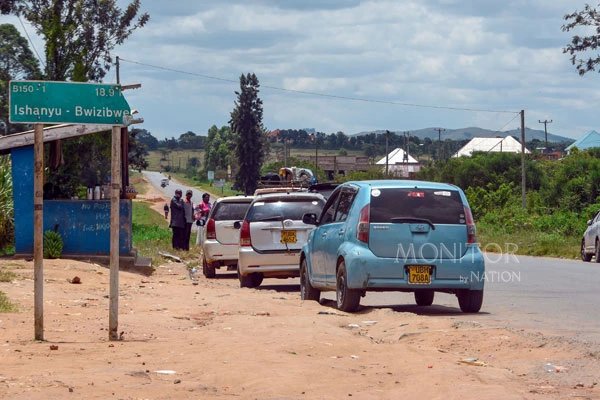
Motorists park at Ishanyu-Buzibwera area in Mbarara District in April 2026
There are people who [receive information, such as about the airport] and strategise to profit. So, if you are sleeping and you are not informed, you will lose out,†he said. Mr Barya said speculators got a windfall in compensation during the construction of the Mbarara Bypass, and the airport project should not be an exception. “It is just [a matter of] using your brains,†he added. The promoters argue that Nyakisharara airport will triple Uganda’s economy and locally spur growth of an aerotropolis: real estate, modern auxiliary facilities, capital inflows, employment and an upswing in hospitality and entertainment businesses.
Modelled as Build, Operate and Transfer (BOT), private companies under an envisaged public-private partnership will pool resources and expertise to construct and run the facility for a specified period, recovering their investments from landing, passengers and cargo levies. While this structure is often presented as limiting taxpayer exposure, analysts warn that risks remain, including false business projections and failure of the project to kick off when its proponents fail to muster the requisite millions of dollars to bankroll it. Mr Dick Omondi, a Kenyan aviation analyst, argued that a decision to develop such an infrastructure must be anchored on commercial considerations.
“[Airport] hubs succeed when there is enough traffic to justify them,†he noted, adding, “Without strong demand, connectivity, and airline capacity, new airports risk becoming underused infrastructure.†Uganda Tourism Board (UTB) said the airport would attract inflows of “high-value tourists going to Bwindi, Mgahinga, Lake Mburo, Queen Elizabeth [National Parks] and [for] Ankole cultural tourism, and businessesâ€. “The airport could reduce travel time, attract luxury and short-stay tourists, and increase visitor circulation in western Uganda,†said Mr Denis Rodney Ojok, a senior tourism official. Government records show that 45,562 and 9,091 tourists visited Bwindi Impenetrable National Park and Mgahinga Gorilla National Park, respectively, last year. The government projects a 40 percent to 50 percent growth in these numbers by the end of this year.
Ms Jean Byamugisha, the chief executive officer of Uganda Hotel Owners’ Association, said Nyakisharara International Airport could become a “catalyst†for growth in the hospitality sector. He urged the government to upgrade roads linking to tourism destinations in western Uganda and establish a Hospitality Training Centre in Mbarara City to graduate fit-for-purpose human capital. In the third instalment tomorrow of our series, Chasing Big Dreams in the Air, we examine how the firms bidding to build Nyakisharara International Airport failed to establish an Aviation and Flight Training Academy, five years after signing a deal with the government.


 Government will not gazette Kijanangoma as King of Tooro for now - Attorney General insists
Ultimate Uganda
Government will not gazette Kijanangoma as King of Tooro for now - Attorney General insists
Ultimate Uganda
 King Oyo’s Body to Arrive Thursday
Ultimate Uganda
King Oyo’s Body to Arrive Thursday
Ultimate Uganda
 Besigye, Lukwago expected to meet Gen. Salim Saleh today at Kapeeke
Ultimate Uganda
Besigye, Lukwago expected to meet Gen. Salim Saleh today at Kapeeke
Ultimate Uganda
 Rwabwogo Advised to ‘Eat His Bishop’ As MK Prepares to Enter State H’se: PREZ MUSEVENI ON HIS WAY OUT
Ultimate Uganda
Rwabwogo Advised to ‘Eat His Bishop’ As MK Prepares to Enter State H’se: PREZ MUSEVENI ON HIS WAY OUT
Ultimate Uganda
0 Comments