
Four-Acre Model farmers decry water scarcity, seek government help on irrigation
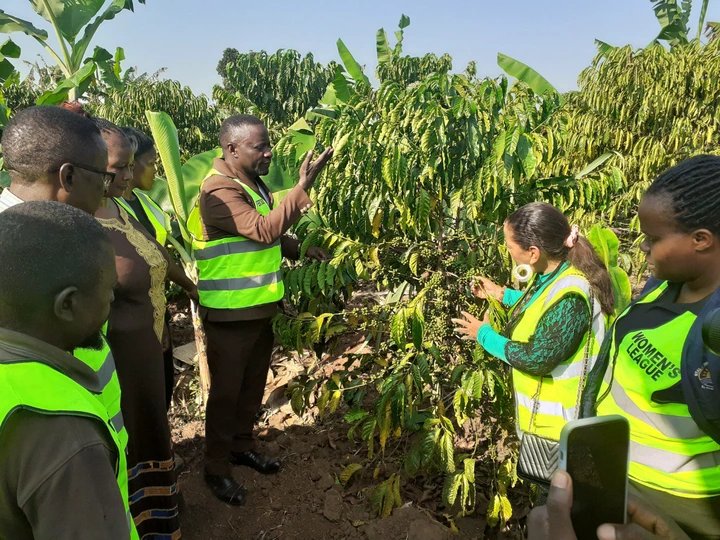

Farmers under President Museveni’s four-acre model in Mityana say water scarcity is their biggest barrier to commercial agriculture, appealing for deep-well drilling.
MITYANA, Uganda — Farmers implementing President Yoweri Museveni’s four-acre model say water scarcity has become one of the biggest obstacles to commercial agriculture, and they are appealing to the government to invest in irrigation infrastructure to keep their farms productive.
The appeals dominated the launch of the SENTFARM Agribusiness Hub, known as Awaka, at Ssebobo Village in Mityana District, where farmers told the senior presidential adviser on agribusiness and value addition, Hillary Emmanuel Musoke Kisanja, that inadequate water sources are undermining the president’s push to turn smallholder farming into a profitable enterprise.
There are born-again Christians who drilled four boreholes for the community, but because demand is so high, the boreholes are dry by around 10 a.m., said Racheal Birabwa Ssentamu, who owns the demonstration farm with her husband, Robert Ssentamu.
The couple appealed to Museveni to provide machinery capable of drilling deep wells, saying persistent water shortages are affecting crop production for many farmers in Ssebobo Village.
Calls for Extension Workers
Birabwa, who has spent three years in farming, also asked the government to deploy more agricultural extension workers, saying farmers need regular technical guidance to succeed.
I have never had an agronomist visit my farm, she said. The few experts I have consulted were privately sourced. If the government wants more people to embrace agriculture, it should assign agronomists at least at the district level to regularly advise farmers.
The couple previously operated a hardware business in Kampala’s Nakasero Market. Birabwa said rising taxes, increasing competition and the economic effects of the COVID-19 pandemic pushed them out of trade and into agriculture, encouraged by the government’s call for alternative sources of income.
After COVID-19, business almost came to a standstill, she said. We met the president as traders to present our challenges. Although we did not receive the support we expected, we were encouraged to venture into farming. I thank Dr. Kisanja for introducing me to agriculture.
Government Acknowledges Mechanization Gap
Kisanja acknowledged that mechanization remains a major challenge for farmers and pledged government support to strengthen the newly launched demonstration farm, which was established under the president’s four-acre model initiative.
We are launching this farm as a model under FAMAOFA, he said, referring to the Four Acre Model Farming Association. I will engage the district leadership to provide the necessary support so that other four-acre model farmers can visit and learn from this project.
The farm consists of mature coffee trees, banana plantations and coffee seedlings irrigated with recycled plastic bottles — a low-cost method Museveni first demonstrated at his Kawumu demonstration farm in Luwero District in 2016.
During a guided tour, Kisanja defended the bottle irrigation technology, saying it provides crops with a steady water supply during dry seasons despite criticism from some politicians when the president first introduced it.
Many people have practiced farming for decades but remained poor, Kisanja said. The president wants Ugandans to treat farming as a business, which is why he introduced the four-acre model.
He said the model was introduced after the government observed increasing land fragmentation in Buganda, where inherited land is often subdivided and sold, leaving many families with plots too small to support traditional farming.
Under the model, a farmer with four acres dedicates one acre to food crops, another to fruits and a third to livestock enterprises such as poultry, dairy cattle, piggery or fish farming, while the remaining acre is used to grow pasture. Kisanja said the integrated approach enables farmers to earn income throughout the year, and that even households with less than four acres can adapt the same principles to maximize productivity.
God has blessed Uganda with fertile land and abundant natural resources, he said. If we fail to utilize them effectively, poverty will persist. Whether it is agriculture, fisheries or mining, we must use our resources wisely.
Kisanja linked household productivity to national economic development, saying the government introduced programs such as the Parish Development Model to support families with startup capital for income-generating activities.
You pass through Nakasero Market and find carrots, oranges, Irish potatoes, beans and many other products imported from Kenya, yet Uganda has fertile soils capable of producing the same commodities, he said.
He urged farmers to organize themselves into groups, noting that government programs are designed to support organized farmer associations rather than individuals.
American Pan-Africanist Calls for Agricultural Investment
The launch was also attended by Queen Nina Womack, an African American Pan-Africanist from Los Angeles who is visiting Uganda as part of an agro-tourism program.
Womack said her interest in Africa stems from years of studying the continent’s history and culture, as well as DNA tests that traced her ancestry to sub-Saharan Africa. She said she has traveled extensively across West Africa since 2019, having been invited to Ghana, where she was crowned a development queen, and later honored with a traditional chieftaincy title in Nigeria before extending her visit to East Africa.
This year I wanted to explore East Africa, Womack said. I have visited Kenya, I am now in Uganda, and next week I will travel to Malawi. I have found Africans to be hardworking, innovative and passionate about agriculture. Unfortunately, much of the Western media portrays Africa negatively and rarely highlights these positive realities.
Kisanja urged Womack to encourage more African Americans to invest in Uganda’s agricultural sector, including in modern irrigation systems, agricultural technologies, organic fertilizers, improved seedlings and modern storage facilities.
Mobilize other African Americans to come and invest in agribusiness, he said. The president is ready to welcome them and facilitate their investment.
He also encouraged farmers to preserve indigenous seed varieties, arguing that locally adapted seeds remain important for sustainable agricultural production.


 Starlink goes live in Uganda; price comparisons against MTN, Airtel
Ultimate Uganda
Starlink goes live in Uganda; price comparisons against MTN, Airtel
Ultimate Uganda
 NSSF sets September 24 for Annual Members Meeting as savers await interest rate declaration
Ultimate Uganda
NSSF sets September 24 for Annual Members Meeting as savers await interest rate declaration
Ultimate Uganda
 Boda boda riders launch e-commerce, digital loans platform
Ultimate Uganda
Boda boda riders launch e-commerce, digital loans platform
Ultimate Uganda
 Rwanda: We Cannot Sit and Watch As Illicit Alcohol Kills People - Kagame
Ultimate Uganda
Rwanda: We Cannot Sit and Watch As Illicit Alcohol Kills People - Kagame
Ultimate Uganda
0 Comments