
Museveni Tells U.N. Sudan Envoy Lasting Peace Requires Elections, Respect for Diversity

We have slightly more than two million refugees, including Congolese and South Sudanese, and many of our cultural groups are connected,†he said.
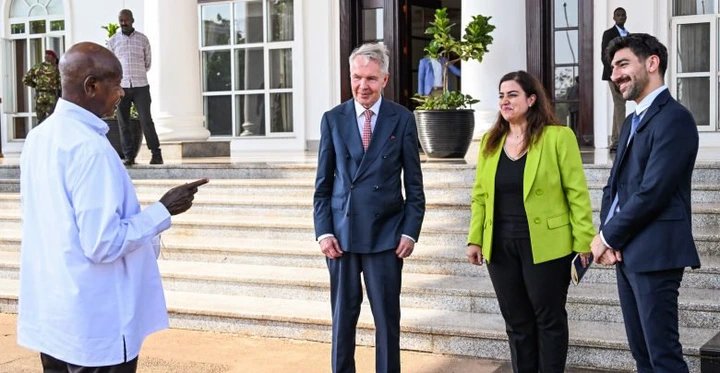
Museveni interacting with the team led by Pekka Haavisto, the United Nations Secretary-General's Personal Envoy for Sudan, at State House Entebbe
ENTEBBE, Uganda — President Yoweri Museveni on Friday told the United Nations Secretary-General’s Personal Envoy for Sudan, Pekka Haavisto, that lasting peace in Sudan would only be achieved by addressing the ideological and political divisions driving the conflict rather than relying on military force.
Museveni made the remarks during talks with Haavisto at State House Entebbe, where the two discussed the ongoing war in Sudan, the worsening humanitarian crisis and broader regional peace and security efforts.
The meeting comes as Sudan’s conflict between the Sudanese Armed Forces (SAF) and the paramilitary Rapid Support Forces (RSF), now in its fourth year, continues to fuel one of the world’s largest humanitarian crises, displacing millions of people and sending refugees into neighbouring countries, including Uganda.
According to State House, discussions focused on strengthening dialogue among the parties to the conflict, enhancing regional cooperation and supporting initiatives aimed at securing a sustainable and inclusive peace.
Pekka Haavisto, the United Nations Secretary-General’s Personal Envoy for Sudan, at State House Entebbe
Museveni argued that Sudan’s recurring instability stemmed from unresolved ideological questions.
“There is an ideological crisis. We have been telling them for years that they should respect the identities of their people. If people do not agree, why don’t they go for elections? Using force to settle political differences is a wrong idea,†Museveni said.
The President cautioned against what he described as “sovereignism†in multinational states, arguing that attempts to impose a single national identity on diverse societies had repeatedly fuelled political crises across Africa.
He urged all parties to the conflict to remain committed to dialogue and appealed to regional and international actors supporting the peace process to prioritise negotiation over confrontation in pursuit of a lasting political settlement.
Museveni also reaffirmed Uganda’s longstanding commitment to hosting refugees, saying the country’s policy was rooted in humanitarian principles as well as deep historical and cultural ties shared across the region.
“These refugees are our people. They are contributing and building Uganda. They come with knowledge, so we don’t mind. They can come because this is their country. We have slightly more than two million refugees, including Congolese and South Sudanese, and many of our cultural groups are connected,†he said.
Pekka Haavisto’s team listening to Museveni’s remarks
Uganda hosts one of Africa’s largest refugee populations, sheltering people fleeing conflicts in South Sudan, the Democratic Republic of Congo and Sudan.
Its open-door refugee policy has earned international recognition, although humanitarian agencies have warned that funding shortages are increasingly straining services for both refugees and host communities.
Haavisto praised Uganda for continuing to provide refuge to those fleeing violence.
“I want to thank Your Excellency for hosting so many Sudanese refugees. Everyone recognises that effort and the United Nations is very grateful that Uganda has kept its doors open to refugees,†he said.
The U.N. envoy said the organisation remained engaged with the warring parties through dialogue on humanitarian access, the release of detainees and support for young people whose lives and education had been disrupted by the conflict.
Haavisto added that Museveni’s engagement with both sides of the Sudanese conflict placed him in a unique position to contribute to ongoing peace efforts.
He expressed optimism that sustained dialogue, backed by regional and international support, could improve the situation and pave the way for lasting peace and stability in Sudan.
Uganda has consistently sought to play a mediating role in regional conflicts, including in South Sudan, eastern Democratic Republic of Congo and Sudan, while simultaneously hosting refugees displaced by violence across the region.


 Government will not gazette Kijanangoma as King of Tooro for now - Attorney General insists
Ultimate Uganda
Government will not gazette Kijanangoma as King of Tooro for now - Attorney General insists
Ultimate Uganda
 King Oyo’s Body to Arrive Thursday
Ultimate Uganda
King Oyo’s Body to Arrive Thursday
Ultimate Uganda
 Besigye, Lukwago expected to meet Gen. Salim Saleh today at Kapeeke
Ultimate Uganda
Besigye, Lukwago expected to meet Gen. Salim Saleh today at Kapeeke
Ultimate Uganda
 Rwabwogo Advised to ‘Eat His Bishop’ As MK Prepares to Enter State H’se: PREZ MUSEVENI ON HIS WAY OUT
Ultimate Uganda
Rwabwogo Advised to ‘Eat His Bishop’ As MK Prepares to Enter State H’se: PREZ MUSEVENI ON HIS WAY OUT
Ultimate Uganda
0 Comments