
How parish-level economic programs helped NRM regain Buganda support
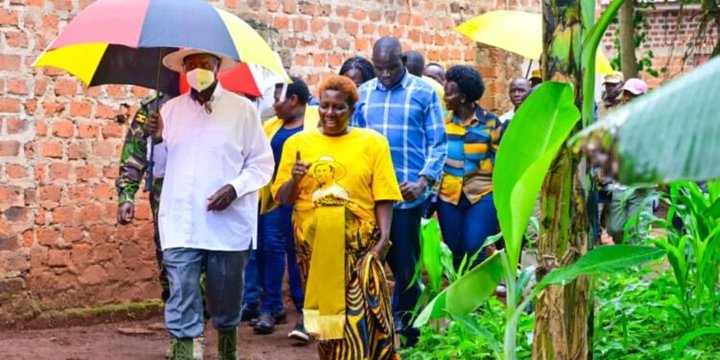

PDM beneficiary Damali Nakayenga (R) chats with President Museveni as she leads him to her piggery farm at her home in Kikoma, Wobulenzi town on Tuesday (PHOTO/ PPU)
KAMPALA – In 2021, the National Resistance Movement faced a political crisis in Buganda. President Yoweri Museveni’s party saw its national vote share drop to 35.91%, with the central region becoming the engine of an opposition surge that left the ruling party reeling.
By the 2026 election, the map had changed. The NRM’s national vote share climbed to 49.25%, fueled by a nearly 14-percentage-point turnaround in the districts surrounding the capital. The reversal was not a product of chance, but of a calculated pivot toward parish-level economic programs that targeted the specific financial frustrations of voters.
Acknowledging the Defeat
The NRM’s path back to dominance began with an internal admission of failure.
“The losses suffered by the NRM party in Buganda subregion in 2021 during the election cycle were big, but we quickly diagnosed the problem by first of all accepting the defeat,†said Rose Namayanja Nsereko, the NRM deputy secretary general.
Namayanja, a key architect of the “Buganda for Museveni†campaign, said the party realized that while opposition propaganda played a role, voters had legitimate grievances regarding service delivery and economic stagnation.
To address this, the party abandoned its traditional national task force model. Instead, it deployed a grassroots mobilization strategy that embedded more than 300 mobilizers per area, including former Resident District Commissioners and party cadres. Their primary tool was the Parish Development Model, or PDM.
“These people had earlier been briefed about the service delivery program and were equipped with the right messages as feedback to the voters, but we also had the PDM as a magic bullet,†Namayanja said.
The PDM and Emyooga as Economic Pivots
Godfrey Kiwanda Ssubi, the former NRM national vice chairperson for Central Region, said the party had to “swallow its pride†and address issues like land grabbing and poverty-related changes that had alienated the population.
He noted that the 2021 election took place under the shadow of the Covid-19 pandemic. The resulting lockdowns angered business owners in Buganda, many of whom carried that frustration to the polling stations. By 2026, the party used the PDM and Emyooga wealth creation programs to repair that relationship.
The impact was visible in the district data:
Buikwe District: With 67 parishes, the district received Shs. 11.07 billion. By 2025, Shs. 9.5 billion had been disbursed to 9,746 beneficiary households.
Wakiso District: To address its high population density, the government tripled PDM funds to Shs. 300 million per parish annually. A total of Shs. 45.3 billion was disbursed to 47,040 households.
Kyankwanzi District: Of the 63,912 households in the district, 57.7%—or 36,291 families—received PDM funds.
Supporting these efforts was Emyooga, which provided capital to savings and credit cooperatives. Wakiso’s 559 SACCOs received Shs. 15.9 billion, while Mubende’s 64 SACCOs received Shs. 3.1 billion. These programs provided a direct financial link between the state and the household, making the NRM’s presence felt at the kitchen-table level.
Youth and Professional Engagement
The NRM also sought to bridge the gap with Buganda’s youthful population, a demographic that had largely favored the opposition in 2021.
Sheikh Kassim Kamigisha, a member of the Patriotic League of Uganda and former Nakawa Division Resident City Commissioner, said the party evolved to meet the needs of young voters.
“In 2021, the NRM party did not have an active youth wing,†Kamigisha said. “The youth have clearly grasped the well-packaged message on the skilling program with the assurance that they can become entrepreneurs and self-employed.â€
Mrs Yapsiwa Doreen – A beneficiary of PDM and engaged in zero grazing, bananas, Coffee planting – Situated in Kakpukole village, Kobil parish, Kawowo S_C, Tingey county, Kapchorwa district.
Peter Kahindi, a lawyer and public policy analyst, said the village-based structures allowed for a more authentic dialogue between the government and the governed.
“When you allow the village-based structures to freely engage with the voters from their respective areas, the people will freely air out their concerns and perhaps get to find the solutions,†Kahindi said.
Infrastructure and Service Delivery
The economic programs were backed by a surge in local infrastructure projects. In Buikwe, safe water access reached 98% of villages, anchored by the Buikwe Town Piped Water system serving 91,356 people. In Wakiso, 99% of villages gained access to safe water.
Education also became a focal point. In Kyankwanzi, the construction of four seed secondary schools began closing the gap in subcounties that previously lacked government facilities. In Mubende, three seed schools were built, and the Presidential Industrial Hub skilled 1,141 residents.
Rosemary Sseninde, who heads national mobilization at the NRM secretariat, said the cumulative effect of these programs changed the narrative in urban centers like Kampala.
“The people of Kampala are rejecting the opposition lies,†Sseninde said, noting that the NRM managed to reclaim three parliamentary seats in the city. By December 2025, more than 514,000 households across Buganda had accessed PDM funds.
President Yoweri Kaguta Museveni with the guidance of Kazibwe Michael a PDM model farmer admires the cow project at Kazibwe Family Mixed Farm in Namazala LC 1 Village, Busede Sub-County, Butembe County, Jinja District, this was during the Presidential Zonal Tour for Busoga Sub-region on the 22nd January 2024. Photos by PPU/Tony Rujuta.
Opposition and Voter Reactions
The NRM’s gains were further aided by fragmentation within the opposition. 128 Independents in Buganda agreed to step down in favor of NRM flagbearers following intervention from party chairperson Yoweri Museveni.
Catherine Nabawanuka, a resident of Bombo Town Council, said the lack of leadership within the National Unity Platform played a role in the shift.
“I don’t believe that the NRM has really worked hard as far as service delivery is concerned, but we have a weak opposition,†Nabawanuka said. “Some of the voters in Luweero now believe that the opposition has no future and have turned back to the NRM party.â€
However, Denis Ssekabira, the Member of Parliament for Katikamu North, argued that the NRM’s success was based on using government resources for partisan hunting.
“The hoes ended up in the hands of the NRM candidates as campaign tools for vote hunting. This is unfortunate,†Ssekabira said, referring to recent agricultural distributions.
Despite the criticism, the results in districts like Nakaseke and Bukomansimbi—where the NRM reclaimed multiple parliamentary seats—show that the focus on parish-level economics resonated. By shifting the conversation from national politics to local household income, the NRM turned its 2021 retreat into a 2026 resurgence.


 Government will not gazette Kijanangoma as King of Tooro for now - Attorney General insists
Ultimate Uganda
Government will not gazette Kijanangoma as King of Tooro for now - Attorney General insists
Ultimate Uganda
 King Oyo’s Body to Arrive Thursday
Ultimate Uganda
King Oyo’s Body to Arrive Thursday
Ultimate Uganda
 Besigye, Lukwago expected to meet Gen. Salim Saleh today at Kapeeke
Ultimate Uganda
Besigye, Lukwago expected to meet Gen. Salim Saleh today at Kapeeke
Ultimate Uganda
 Rwabwogo Advised to ‘Eat His Bishop’ As MK Prepares to Enter State H’se: PREZ MUSEVENI ON HIS WAY OUT
Ultimate Uganda
Rwabwogo Advised to ‘Eat His Bishop’ As MK Prepares to Enter State H’se: PREZ MUSEVENI ON HIS WAY OUT
Ultimate Uganda
0 Comments