
URA Raises PAYE Tax-Free Threshold to Shs335,000 From Shs235,000

KAMPALA: Uganda is planning sweeping changes to its personal income tax system to ease pressure on low-income earners, even as it rolls out new tax measures to recover at least 49 billion Ugandan shillings in additional revenue, according to official proposals for the 2026/27 financial year seen by ChimpReports.
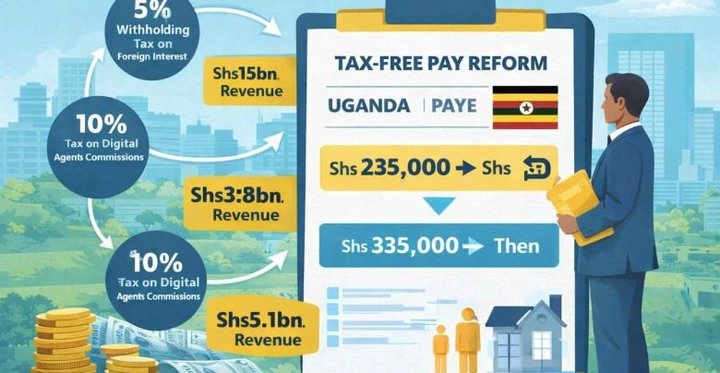
At the centre of the reforms is a long-awaited adjustment of the Pay-As-You-Earn (PAYE) threshold, which would raise the tax-free monthly income band to 335,000 shillings from the current 235,000 shillings — a level that has remained unchanged since 2012 despite years of inflation and rising living costs.
The change is expected to deliver immediate relief to salaried workers, particularly those in lower income brackets, but will reduce government revenue by an estimated 96 billion shillings in the first year.
Officials say the reform is intended to correct structural imbalances in the tax system and improve equity.
“The current threshold has not been adjusted for inflation since 2012,†the document states.
“The proposal seeks to address the increase in the cost of living, especially for low-income earners.â€
Under the revised PAYE structure, income up to 335,000 shillings per month would be tax-exempt, while earnings between 335,000 and 410,000 shillings would be taxed at 20%. Income between 410,000 and 485,000 shillings would attract a 25% rate, rising to 30% for earnings up to 10 million shillings, and 40% for income above that threshold.
The government acknowledges the immediate fiscal impact but expects the measure to support consumption and productivity, with revenues projected to recover in subsequent years as economic activity expands.
Header advertisement
To offset the shortfall, authorities are proposing a combination of new taxes and compliance-driven reforms.
A key measure is the introduction of a 5% withholding tax on interest payments made by Ugandan companies to foreign financial institutions. The proposal targets a long-standing gap where such payments are not taxed at source, allowing income to flow untaxed across borders.
Revenues
The measure is expected to generate about 15 billion shillings and is aimed at reducing profit shifting and ensuring parity with interest income earned domestically.
In the property sector, individual rental taxpayers would be allowed to file and pay taxes monthly instead of quarterly.
The reform is designed to ease compliance and improve cash flow management for taxpayers, while helping the Uganda Revenue Authority reduce the accumulation of arrears.
The shift is projected to raise about 29 billion shillings annually.
Authorities are also seeking to expand the scope of withholding tax in the telecom sector by imposing a 10% levy on commissions earned by agents distributing data and voice bundles. Currently, similar taxes apply mainly to airtime and mobile money agents.
The expansion is expected to yield approximately 5.1 billion shillings and is part of a broader push to widen the tax base in fast-growing digital sectors.
The proposals come as Uganda intensifies efforts to strengthen domestic revenue mobilisation amid rising public spending needs, including infrastructure development and social services.
Tax authorities have increasingly leaned on both policy reforms and digital monitoring systems to improve compliance, with officials arguing that closing leakages and broadening the base is critical to sustaining economic growth without excessive borrowing.
($1 = approximately 3,800 Ugandan shillings)


 The women who have been in King Oyo’s life
Ultimate Uganda
The women who have been in King Oyo’s life
Ultimate Uganda
 Ex Kagame Guard Commander Tom Byabagamba Dies in Rwandan Prison After 12 Years
Ultimate Uganda
Ex Kagame Guard Commander Tom Byabagamba Dies in Rwandan Prison After 12 Years
Ultimate Uganda
 Government begins salary payments for public sector workers – Reform Committee
Ultimate Uganda
Government begins salary payments for public sector workers – Reform Committee
Ultimate Uganda
 Temangalo land: NSSF, Nzenyi reach agreement
Ultimate Uganda
Temangalo land: NSSF, Nzenyi reach agreement
Ultimate Uganda
0 Comments