
Besigye lawyers, prosecution clash over legality of concealing witnesses
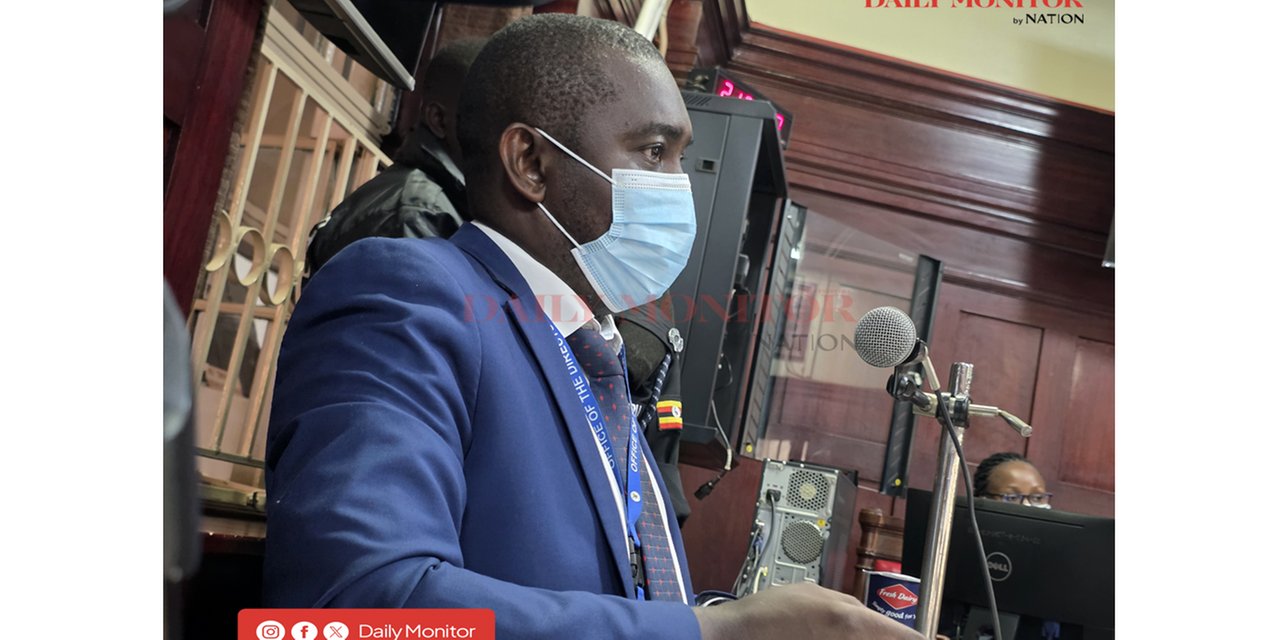

Chief State Attorney Joseph Kyomuhendo during cross-examination in Col Dr Kizza Besigye's case on Thursday. Photo | Juliet Kigongo
Tension gripped the High Court on Thursday as defence lawyers for opposition figure Col Dr Kizza Besigye subjected Chief State Attorney Joseph Kyomuhendo to a rigorous cross-examination, exposing sharp disagreements over the legal basis for concealing prosecution witnesses in the ongoing treason trial.
Mr Kyomuhendo, the head of the Anti-Trafficking Department in the Office of the Director of Public Prosecutions (DPP), took the stand to defend the State’s application to shield the identities of key witnesses.
However, under cross-examination led by defence lawyer Fredrick Mpanga, histestimony revealed contradictions and concessions that could weigh heavily on the court’s final determination.
At the outset, Chief State Attorney Richard Birivumbuka asked court to limit the number of lawyers cross-examining the witness to avoid wastage of time and also sought to block live streaming of proceedings.
But trial judge Emmanuel Baguma declined to entertain the request, directing that the hearing proceed.
During cross-examination, Mr Mpanga pressed Mr Kyomuhendo on whether Uganda’s legal framework explicitly provides for witness protection.
“You confirm that there is no constitutional or statutory provision that provides for witness protection in Uganda?†Mr. Mpanga asked.
“It’s not correct,†Mr. Kyomuhendo responded, initially maintaining that the right to a fair hearing under Article 28 of the Constitution accommodates such protections.
But under sustained questioning, Mr Kyomuhendo later conceded that there is no statute for witness protection, adding that such measures fall within the discretion of the trial judge or magistrate.
Mr Mpanga took advantage of the admission, insisting that the State’s application lacked a firm legal foundation.
The defence further challenged Mr Kyomuhendo’s reliance on constitutional interpretation, particularly his citation of case law suggesting that the right to disclosure is not absolute.
Mr. Kyomuhendo argued that while accused persons are entitled to prepare their defence, the State is not obligated to disclose all evidence where exceptions apply.
“The right to disclosure is not absolute. There are exceptions, including protection of informers and state interests,†he told court.
But Mpanga countered that such positions cannot override the absence of a clear statutory regime, warning that the prosecution was effectively inviting court to create law through discretion.
The exchange grew more pointed when Mr. Kyomuhendo described himself as both a witness of fact and law — a position the defence argued was improper.
“Are you testifying as a witness of fact or of the law?†Mr. Mpanga pressed.
“Both,†Kyomuhendo replied. “I am here to testify about concealment of witnesses and where facts arise, I will address them.â€
Mr. Mpanga challenged the approach, reminding him that affidavits must stand on their own as evidence.
“If the affidavit is lacking in evidence, the application should collapse,†Mr. Mpanga said.
“That is for court to determine,†Mr. Kyomuhendo responded.
The defence also questioned the State’s justification for secrecy in a case being heard before the Criminal Division of the High Court, rather than the International Crimes Division, which has previously handled cases involving protected witnesses.
“Are you aware that these divisions are different?†Mr. Mpanga asked.
“To me, they are the same,†Mr. Kyomuhendo answered, before conceding that procedures are “slightly different.â€
On the issue of risk to witnesses, Mr. Kyomuhendo maintained that treason cases inherently carry danger.
“For cases like treason, I don’t have to wait for harm to happen before taking action,†he said. “There is a high likelihood of reprisal.â€
He added that even though Besigye and his co-accused are in custody, they could still pose a threat to prosecution witnesses.
However, the defence dismissed the claim as speculative, noting that no evidence of actual threats had been presented.
They further accused the State of acting prematurely by concealing witness identities before obtaining court approval.
“You are asking court to sanction something you have already done,†Mr. Mpanga argued, describing the move as an abuse of process.
Mr. Kyomuhendo rejected the accusation, saying the prosecution acted out of caution.
“We were being courteous to the defence,†he said, insisting that no error had been made.
The cross-examination also touched on internal DPP mechanisms, with Mr. Kyomuhendo confirming the existence of witness protection guidelines.
However, when asked to produce a formal policy, he presented guidelines instead and equated them to policy.
The hearing forms part of a broader challenge by Besigye and his co-accused, who argue that concealing witnesses would undermine their right to a fair trial in a capital offence.
In earlier filings, the defence warned that anonymity would lead to trial by ambush, preventing them from effectively testing the prosecution’s case.
The State, however, maintains that limited disclosure and use of pseudonyms are necessary to protect witnesses and ensure justice is served.
Justice Baguma has adjourned the matter to May 6 and 10 for further cross-examination.
Background
The objection arises from an application by the prosecution seeking to protect the identities of six out of ten witnesses in the treason case against Besigye, Lutale and UPDF officer Denis Oola.
The State alleges that the accused, together with others still at large, plotted to overthrow the government by force between 2023 and November 2024, with alleged meetings held in Geneva, Athens, Nairobi and Uganda.


 Government will not gazette Kijanangoma as King of Tooro for now - Attorney General insists
Ultimate Uganda
Government will not gazette Kijanangoma as King of Tooro for now - Attorney General insists
Ultimate Uganda
 King Oyo’s Body to Arrive Thursday
Ultimate Uganda
King Oyo’s Body to Arrive Thursday
Ultimate Uganda
 Besigye, Lukwago expected to meet Gen. Salim Saleh today at Kapeeke
Ultimate Uganda
Besigye, Lukwago expected to meet Gen. Salim Saleh today at Kapeeke
Ultimate Uganda
 Rwabwogo Advised to ‘Eat His Bishop’ As MK Prepares to Enter State H’se: PREZ MUSEVENI ON HIS WAY OUT
Ultimate Uganda
Rwabwogo Advised to ‘Eat His Bishop’ As MK Prepares to Enter State H’se: PREZ MUSEVENI ON HIS WAY OUT
Ultimate Uganda
0 Comments