
KCCA rolls out paid waste system to tackle city garbage crisis
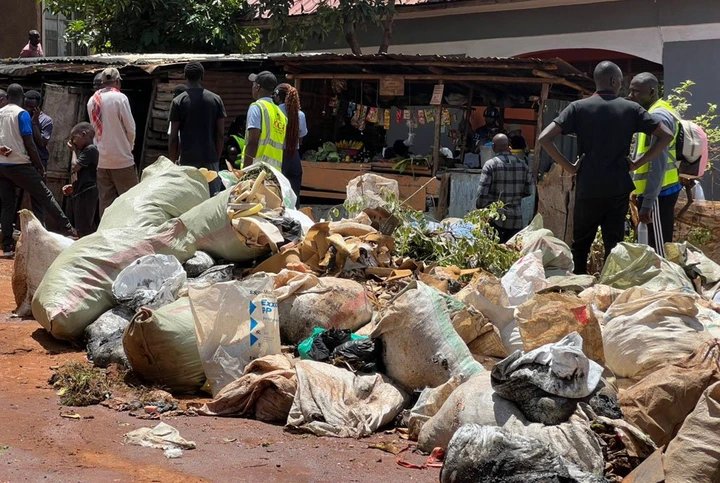

For years, garbage collection in Kampala has largely been treated as a public service many residents expect but few feel responsible for sustaining. Piles of uncollected waste, clogged drainage channels, and illegal dumping have become a familiar sight across the city.
Now, city authorities are taking a firmer stance, introducing mandatory monthly garbage fees while pushing a behaviour change campaign that seeks to fundamentally redefine how residents think about waste.
At the centre of this shift is the Kampala Capital City Authority (KCCA), which has rolled out a structured payment system for garbage collection alongside its ongoing Weyonje campaign, an initiative aimed at promoting cleanliness and personal responsibility.
Speaking during a community engagement in Kawempe Division on April 18, KCCA Executive Director Hajati Sharifah Buzeki said the new measures are not just about improving waste collection, but about correcting a long-standing culture of neglect.
“For a long time, people have assumed that government alone should handle waste, but the truth is, every individual generates waste and must take responsibility for it,†she said.
Paying for what you throw away
The initiative, which was launched last month in Kampala during sanitation week, will see households pay Shs3,000 per month for garbage collection, while businesses such as shops will be charged Shs5,000 per 50-kilogramme sack.
Ms Buzeki says the fees, though modest, have sparked debate among residents, with some questioning their affordability. But she insists the cost is minimal when broken down.
“That is about Shs100 a day,†she explained. “It is a small contribution to ensure that waste is collected and disposed of safely. This is about protecting public health and maintaining dignity as a city.â€
She added that the fees are also meant to create accountability, encouraging residents to see waste management not as a free service, but as a shared responsibility.
Beyond cleanups: Changing mindsets
Ms Buzeki added that while the introduction of fees is a structural shift, KCCA believes lasting change will depend on transforming public attitudes. This is where the Weyonje campaign comes in. Running weekly across different divisions, the campaign combines community cleanups with sensitisation efforts aimed at promoting better waste habits.
“Our Weyonje campaigns are not just about cleaning; they are about changing how people think about waste, from how it is generated to how it is managed,†she said.
She added that a key message emerging from the campaign is the expansion of the traditional “three Rsâ€, reduce, reuse, recycle, to include a fourth principle: refuse.
“The three Rs are not enough. We are now saying refuse. Why accept unnecessary packaging? Why take extra polythene bags when you don’t need them? That is where waste begins.â€
By encouraging residents to reject excess packaging and separate waste at source, KCCA hopes to reduce the overall volume of garbage generated across the city.
Kawempe as a testing ground
She also revealed that in Kawempe Division, particularly in Lugoba, the impact of the Weyonje campaign is already visible.
“Once characterised by heaps of garbage and blocked drainage channels, parts of the area have undergone a noticeable transformation following consistent weekly cleanups since February 2025,†she said.
Ms Buzeki pointed out that households can reduce what they pay by generating less waste.
“If you refuse unnecessary packaging and separate your waste, you will have less to dispose of. This system rewards responsible behaviour,†she said.
The approach aligns financial incentives with environmental responsibility, encouraging residents to think more critically about consumption and waste.
Influence beyond government
The Weyonje campaign has also drawn support from artists and public figures, who are helping to amplify its message.
During the Kawempe cleanup, musician Carol Namulindwa, also known as Karole Kasita, emphasised the role of public figures in shaping community behaviour.
“Being an artist is not just about entertainment; it is about influence,†she said. “When we come here to clean, we are encouraging people to take pride in their environment.â€
She urged residents to sustain the effort beyond organised cleanups.
“We may leave, but the responsibility stays with you. Cleanliness should be part of daily life,†she said.
A long-term vision for Kampala
As the Weyonje campaign expands to other divisions, KCCA is hopeful that the combination of behavioural change and structured waste management will deliver lasting results.
“If we combine regular cleanups, responsible waste generation, and a reliable collection system supported by these small payments, we can transform Kampala,†Buzeki said.
For a city long grappling with a garbage crisis, the shift from free disposal to paid responsibility, and from indifference to ownership, may prove to be the turning point.


 The women who have been in King Oyo’s life
Ultimate Uganda
The women who have been in King Oyo’s life
Ultimate Uganda
 Ex Kagame Guard Commander Tom Byabagamba Dies in Rwandan Prison After 12 Years
Ultimate Uganda
Ex Kagame Guard Commander Tom Byabagamba Dies in Rwandan Prison After 12 Years
Ultimate Uganda
 Government begins salary payments for public sector workers – Reform Committee
Ultimate Uganda
Government begins salary payments for public sector workers – Reform Committee
Ultimate Uganda
 Temangalo land: NSSF, Nzenyi reach agreement
Ultimate Uganda
Temangalo land: NSSF, Nzenyi reach agreement
Ultimate Uganda
0 Comments