
UCC clarifies tax study after social media backlash
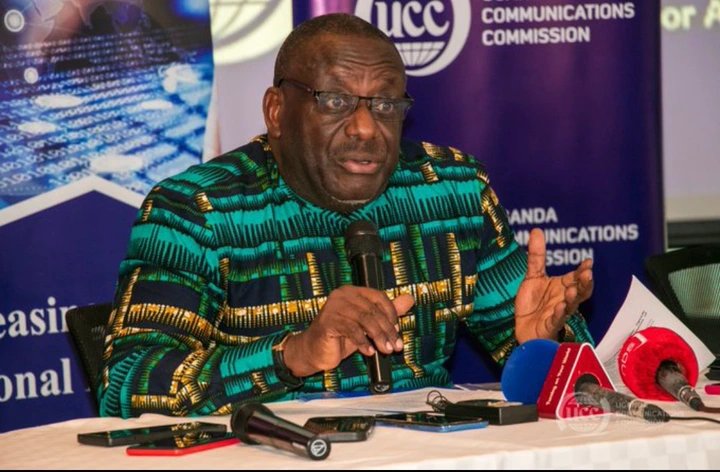

UCC Executive Director Nyombi Thembo announced the return of web services Jan. 18, while keeping a temporary ban on social media and messaging apps.
Uganda’s communications regulator has clarified the findings of a report on telecommunications taxation, after social media commentary used the study to draw what it called unfair comparisons with other countries.
The Uganda Communications Commission (UCC) commissioned the report, Impact of the Current Telecommunications Taxation Policy on the Communications Sector, which concluded that taxes on data, airtime, mobile money and smartphones are increasing costs for consumers, slowing digital adoption and potentially limiting future investment and growth in Uganda’s digital economy. It described the sector’s tax burden as one of the heaviest and most distortionary tax regimes in the region.
Many social media users seized on that finding to argue Uganda’s telecoms taxes are unusually high by regional standards. UCC’s executive director, Nyombi Thembo, said this had not been the report’s intent.
The commission’s mandate, under the Communications Act, is regulatory and advisory, not fiscal — tax policy is set by the Ministry of Finance. UCC said the report’s actual purpose was to support its own proposal to the Treasury for reducing or removing tax on entry-level smartphones, as part of a broader digital inclusion drive, rather than to provide a basis for cross-country comparison.
The regulator argued that Uganda’s tax-to-GDP ratio, at 13.1–13.6%, is low relative to other Sub-Saharan African economies, and that government will need to keep looking at fast-growing sectors like ICT to widen the national revenue base. It said current tax levels are not, in its assessment, holding back growth in the sector — a claim that sits uneasily next to the report’s own data.
That data shows major telecom operators MTN and Airtel contributed 12.7% of total VAT revenue and accounted for 40% of total excise duty revenue in the 2019/20 financial year, even as the sector’s proportional contribution to GDP declined from a peak of 2.3% in 2015 to 1.8% in 2020. Consumers currently pay 18% VAT and 12% excise duty on mobile and internet services, while imported ICT devices and infrastructure face duties ranging from 10% to 25%.
UCC tied the tax debate to two other government priorities: investment in energy infrastructure to support data centres and artificial intelligence, and the Parish Development Model, a programme intended to raise household incomes and, over time, smartphone affordability. With an estimated 20 million smartphone users nationally, the commission said cheaper devices would let operators expand networks and potentially lower data costs.
The clarification follows wider recommendations UCC has already submitted to government, including a reduction in VAT on digital devices and a lower excise duty on data bundles below one gigabyte, and the removal or reduction of VAT and excise taxes on entry-level smartphones. It has also proposed ring-fencing a portion of telecommunications sector revenues to finance digital inclusion initiatives.
Mobile data in Uganda currently costs about five thousand shillings for one gigabyte, and the country ranks 91st out of 193 countries on the Global e-Participation Index.


 Government will not gazette Kijanangoma as King of Tooro for now - Attorney General insists
Ultimate Uganda
Government will not gazette Kijanangoma as King of Tooro for now - Attorney General insists
Ultimate Uganda
 King Oyo’s Body to Arrive Thursday
Ultimate Uganda
King Oyo’s Body to Arrive Thursday
Ultimate Uganda
 Besigye, Lukwago expected to meet Gen. Salim Saleh today at Kapeeke
Ultimate Uganda
Besigye, Lukwago expected to meet Gen. Salim Saleh today at Kapeeke
Ultimate Uganda
 Rwabwogo Advised to ‘Eat His Bishop’ As MK Prepares to Enter State H’se: PREZ MUSEVENI ON HIS WAY OUT
Ultimate Uganda
Rwabwogo Advised to ‘Eat His Bishop’ As MK Prepares to Enter State H’se: PREZ MUSEVENI ON HIS WAY OUT
Ultimate Uganda
0 Comments