
Uganda to split aviation regulator from airport operations by 2027

UCAA Director General Fred Bamwesigye addresses the media at the end of a full-scale aviation security exercise in Entebbe on June 26, 2026. Photo by Eve Muganga.
The Uganda Civil Aviation Authority (UCAA) plans to separate its regulatory and airport operations functions by mid-2027 in a move aimed at strengthening oversight, improving efficiency and eliminating potential conflicts of interest.
UCAA Director General Fred Bamwesigye announced the plan on Friday after the authority conducted a full-scale aviation security exercise at Entebbe International Airport.
"In the recent past we have been working on a project to separate the aspects of regulation and oversight from operations, to separate the civil aviation regulator from airport operation to avoid conflict of interest," Mr Bamwesigye said.
He said the restructuring would allow one entity to focus exclusively on regulating the aviation industry while another manages airport operations.
"The continued growth of Uganda's aviation industry requires that the authority carries out industry oversight without any compromise and leaves airport operations to a separate entity," he said.
"We are taking our time to do this in an orderly manner so as to ensure that the two emerging entities are sustainable, the airport operator and the civil aviation regulator."
Mr Bamwesigye said the legal framework for the separation would be submitted to Cabinet and Parliament by the middle of next year.
"By mid next year, we will have come out with the instruments for separation for approval by Cabinet and Parliament, with the attendant Acts of Parliament and regulations that govern the industry," he said.
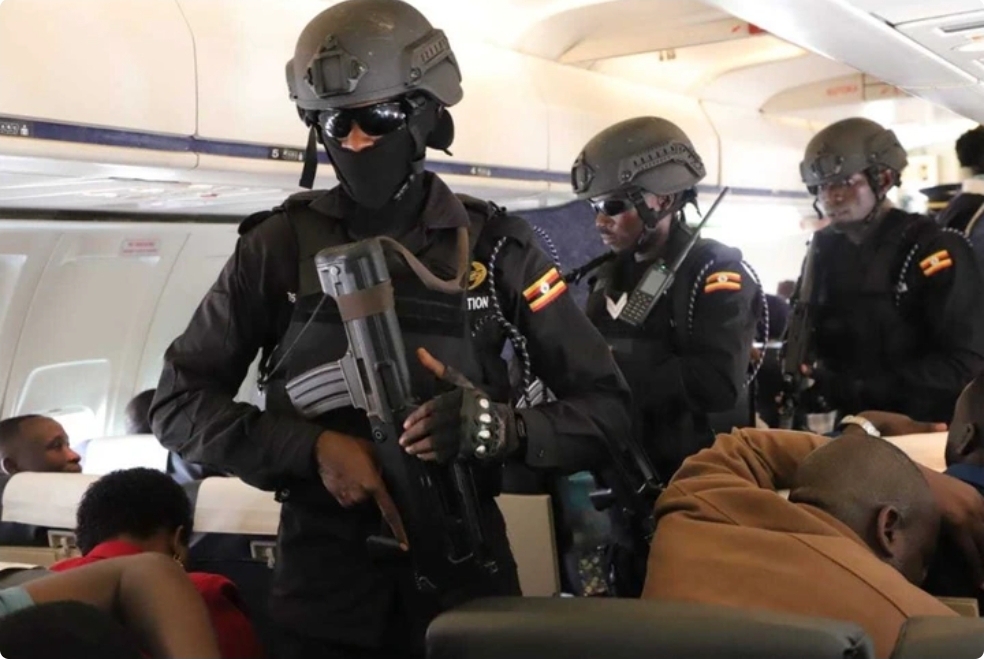
The announcement came after UCAA carried out a two-and-a-half-hour aviation security drill, codenamed EX 2026, to assess the preparedness of agencies responding to an aircraft hijacking.
The exercise, which began at about 12:14 p.m., simulated the hijacking of a Fenna Airlines aircraft carrying 67 people, including 62 passengers and five crew members.
According to the scenario, a hijacker gained access to the cockpit before take-off after the pilot briefly stepped out, overpowered the co-pilot and assumed control of the aircraft.
The simulation included a ransom demand, negotiations with the perpetrator and a coordinated security response involving multiple agencies.
Mr Bamwesigye said the exercise tested inter-agency coordination, emergency response systems and airport incident management under high-pressure conditions.
He noted that such drills are mandatory for international airports in member states of the International Civil Aviation Organization (ICAO) and are conducted every two years to validate airport contingency plans.
The exercises are required under Annex 17 of the Chicago Convention and Uganda's Civil Aviation Security Regulations 2022.
Security personnel participate in a full-scale aviation security exercise on June 26, 2026. Courtesy photo.
Mr Bamwesigye commended security agencies, airline operators, ground handling companies, health personnel and other government agencies that participated in the simulation.
Following the exercise, participating agencies held a debriefing session to identify strengths and areas requiring improvement.
"These debriefings consistently produce valuable feedback and are an essential part of our preparedness process," he said.
UCAA last conducted a full-scale aviation security exercise in October 2023, followed by a tabletop exercise in 2024. A separate full-scale aviation safety exercise was held in May 2025.
Mr Bamwesigye said Uganda recently scored 81.6 percent in the International Civil Aviation Organization's Universal Security Audit Programme–Continuous Monitoring Approach (USAP-CMA), exceeding both regional and global averages


 Starlink goes live in Uganda; price comparisons against MTN, Airtel
Ultimate Uganda
Starlink goes live in Uganda; price comparisons against MTN, Airtel
Ultimate Uganda
 NSSF sets September 24 for Annual Members Meeting as savers await interest rate declaration
Ultimate Uganda
NSSF sets September 24 for Annual Members Meeting as savers await interest rate declaration
Ultimate Uganda
 Boda boda riders launch e-commerce, digital loans platform
Ultimate Uganda
Boda boda riders launch e-commerce, digital loans platform
Ultimate Uganda
 Rwanda: We Cannot Sit and Watch As Illicit Alcohol Kills People - Kagame
Ultimate Uganda
Rwanda: We Cannot Sit and Watch As Illicit Alcohol Kills People - Kagame
Ultimate Uganda
0 Comments