
Drought-Resistant Cassava Offers Hope for Food Security Amid Hunger Crisis in Karamoja
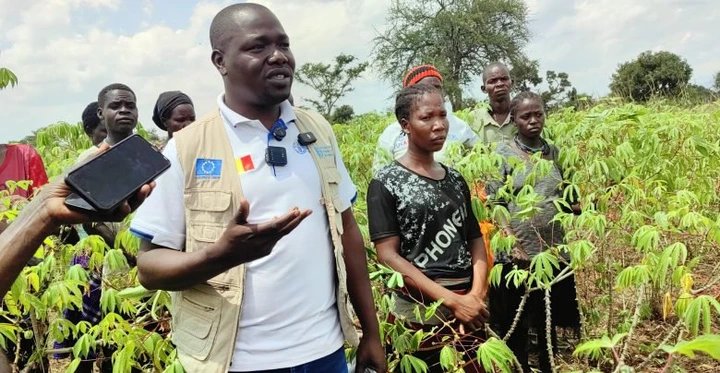

Simon Ekwaru, FOSTER Project Assistant at FAO with cassava farmers in Napak district
A drought-resistant cassava variety is offering a lifeline to communities in Karamoja as the region grapples with a hunger crisis that has claimed at least 16 lives in recent weeks after crops withered under prolonged dry conditions.
Karamoja has received little or no rainfall for months, leaving thousands of families without food as large areas of maize, sorghum, and soybeans dried up. The Office of the Prime Minister said the extended dry spell caused widespread crop failures and severe food shortages, contributing to the deaths.
Amid this bleak outlook, the Ekitaya Kaapei Farmer Field Group in Lorengecora Sub-county, Napak District, has recorded a breakthrough after planting NARO CAS 1, a cassava variety bred to withstand drought and mature quickly. The crop was introduced under the FOSTER project, funded and implemented by the European Union and the Food and Agriculture Organisation of the United Nations (FAO) to improve food security and resilience in the Karamoja sub-region.
Farmers identified cassava multiplication as a key strategy to boost food security. Cassava is a relatively new crop in Karamoja, although it has long been grown successfully in Katakwi in the neighbouring Teso sub-region. After observing how farmers in Teso were using drought-resistant cassava to tackle food insecurity, farmer groups in Karamoja adopted the crop and received cassava cuttings in August last year.
The crop was planted despite an already deteriorating rainfall pattern, yet it has held firm.
“There was quite some little rain for about two months and it disappeared in October. But as we see, the cassava has withstood the harsh conditions of the dry spell and the drought, and it is now ready for harvest,†said Simon Ekwaru, FOSTER Project Assistant at FAO.
For Mary Nayep, a beneficiary of the project, cassava has made a big difference compared to the crops she used to grow. She said sunflower and sorghum, which she depended on before, repeatedly failed because of drought, pests, and diseases.
“Before this cassava project, we were planting sunflower and sorghum but they would be hit hard by drought, pests and diseases, and we would not harvest anything. This cassava has significantly changed that. This cassava is resistant to pests, diseases, and drought that have been affecting our crops,†Nayep said.
“This cassava is of significant importance to us. In Karamoja, we have a challenge of prolonged drought and famine,†she added.
Ekwaru said the scale of the planting means the harvest will extend far beyond household consumption, positioning the farmers for commercial gain.
“10 acres of cassava cannot just be eaten. This is now production for money. So, we have now upgraded these farmers from farmer field school groups to farmer business groups. They are now looking at the enterprise; not only for home consumption, but now for business,†he said.
NARO CAS 1 reaches maturity in just eight months and was approved by FAO in consultation with the Ministry of Agriculture, Animal Industry and Fisheries (MAAIF).
“NARO CAS 1 is very tolerant to drought. As you see, we planted last year and it was heavily hit by the dry spell, but you can see how it is performing. It is now mature and ready for harvest,†Ekwaru said.
The project is being implemented across nine districts: Abim, Amudat, Karenga, Kotido, Moroto, Nabilatuk, Nakapiripirit, and Napak.
“There are a number of potential areas across the subregion where cassava also does well, and we feel that when we get more resources, we want to support cassava production across Karamoja subregion. This will go a long way in helping them to really overcome the issues of food insecurity,†Ekwaru said.
Karamoja sub-region has been struck by catastrophic food shortages before. A 2022 report by the Uganda Human Rights Commission revealed that more than 2,200 people died of starvation and related illnesses in north-eastern Uganda, attributing the hunger to long dry spells that led to acute famine.


 The women who have been in King Oyo’s life
Ultimate Uganda
The women who have been in King Oyo’s life
Ultimate Uganda
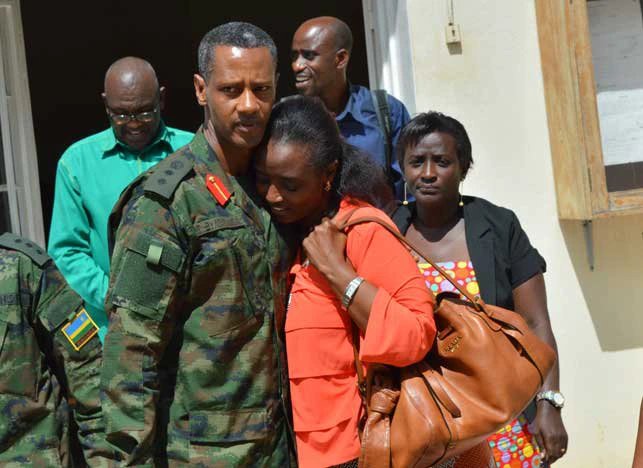 Ex Kagame Guard Commander Tom Byabagamba Dies in Rwandan Prison After 12 Years
Ultimate Uganda
Ex Kagame Guard Commander Tom Byabagamba Dies in Rwandan Prison After 12 Years
Ultimate Uganda
 Government begins salary payments for public sector workers – Reform Committee
Ultimate Uganda
Government begins salary payments for public sector workers – Reform Committee
Ultimate Uganda
 Temangalo land: NSSF, Nzenyi reach agreement
Ultimate Uganda
Temangalo land: NSSF, Nzenyi reach agreement
Ultimate Uganda
0 Comments