
How Corruption Raised Mpigi Expressway Cost to UGX 2Trillion
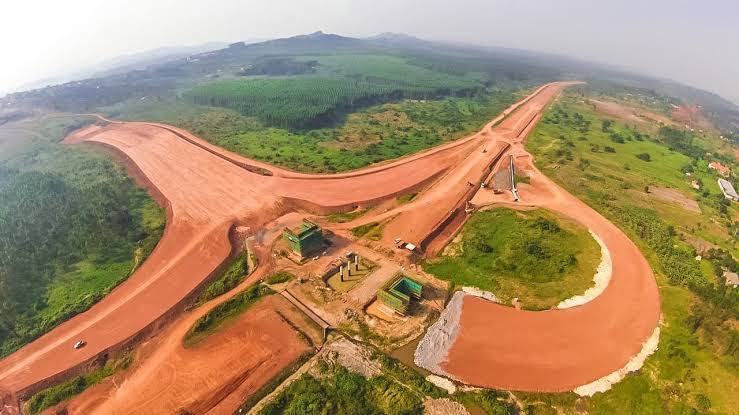

The Busega-Mpigi Expressway project is now expected will have cost more than 2 trillion shillings by the time it is completed, according to Fred Byamukama, the Minister for Works and Transport. This is the result of several factors including delays and project redesigns, but mainly alleged corruption in the ministry, which has so far seen the initial cost double from about 600 billion shillings to 1.3 trillion.
The project was rerouted from built-up areas to go through mainly the swampy areas, which was seen as a move to save money what would have gone into compensating and relocating properties in Wakiso and Mpigi district.
However, Minister Byamukama says the rerouting of the project through the swamp was instead a ploy by some ministry officials and unscrupulous persons who has acquired land in the swampy areas. Two engineers, Dickens Ahimbisibwe and Edwin Raymond Kiyaga, have been suspended and Permanent Secretary Bageya Waiswa sent of forced leave, in connection to activities related to corruption in the project.
The Minister says that now, the 23km-project requires another 700 billion shillings to complete, adding that the contractor has since resumed work, with new terms and conditions to complete the project by the end of 2028. Construction work commenced in 2020 and was projected to be completed by end of 2026, but for a number of setbacks, including land acquisition challenges, design and scope revisions.
“Government has since secured additional funding and works have resumed,†he said. “While we work towards resolving the project’s bottlenecks, we want to ensure that the contractor maintains steady progress towards the project delivery.â€
Allan Ssempebwa, a communications officer at the ministry says that works are now at 47 percent completion, with the contractor “expected to scale up efforts and have the game changer project ready†by end of 2028.
He, however, explains that the 1.3 trillion shillings is meant for the Busega–Mpigi Expressway itself, while the additional 700 billion relates to the proposed Busega Systems Interchange, which was originally planned under the Kibuye–Busega Expressway Project.
“The proposed interchange is intended to connect the Busega–Mpigi Expressway to the Kampala Northern Bypass, Kampala–Entebbe Expressway, Kampala–Masaka Highway, the existing Kibuye–Natete–Busega corridor and in future, Kibuye-Busega expressway,†he says.
Kibuye-Busega Expressway was planned as a separate project with separate funding, but the ministry is now considering integrating it into the ongoing Busega–Mpigi Expressway as a comprehensive plan to tackle traffic congestion in the area. The other major road redesigns included the additional interchanges; Busega Interchange, Nabbingo Interchange, Maya Interchange Lungala Interchange and Mpigi Interchange.
The project will therefore have four toll plazas or gates, service lanes, and an additional seven bridges to support full toll-road operations, which were not in the original scope. It also takes the expressway total length to 27.3 km with enhanced drainage of over 50 km of channels.
The Minister says that AfDB is still willing to finance the project which is expected to be paid from by users through the tolling system. In November last year, the AfDB Board said it had approved to provide 217.37 million euro, and a NEPAD grant of 1 million dollars, while the Government of Uganda would contribute 30.98 million euro, bringing the total cost of the project section 424.61 million euro (1.795 trillion shillings), up from the original 176.26 million (745 billion shillings).
The year 2015 was project formative year when detailed engineering designs including Environmental and Social Impact Assessment were undertaken following the completion of the environment and socio-economic studies in 2014.
In 2016, government sealed the financing deal with the African Development Bank worth 151 million dollars or close to 550 billion shillings at the time, with the government expected to contribute 41 million dollars (about 140 billion shillings) in counterpart funding.
In 2019, civil works were due to commenced on 22nd November; but were delayed by requests for extensions of the environmental and social impact assessment which had already expired. Construction works officially began in May 2020, with contractors establishing site camps and initiating heavy works, with a completion deadline set for 2023.
Other key factors contributing to delays were funding gaps and interruptions, which leads to the contractor to claim losses due to idle contractor equipment; land acquisition and compensation issues; the outbreak of COVID-19 that heavily impacted the construction sector and supply chains; as well as weaknesses in the procurement processes.


 Government will not gazette Kijanangoma as King of Tooro for now - Attorney General insists
Ultimate Uganda
Government will not gazette Kijanangoma as King of Tooro for now - Attorney General insists
Ultimate Uganda
 King Oyo’s Body to Arrive Thursday
Ultimate Uganda
King Oyo’s Body to Arrive Thursday
Ultimate Uganda
 Besigye, Lukwago expected to meet Gen. Salim Saleh today at Kapeeke
Ultimate Uganda
Besigye, Lukwago expected to meet Gen. Salim Saleh today at Kapeeke
Ultimate Uganda
 Rwabwogo Advised to ‘Eat His Bishop’ As MK Prepares to Enter State H’se: PREZ MUSEVENI ON HIS WAY OUT
Ultimate Uganda
Rwabwogo Advised to ‘Eat His Bishop’ As MK Prepares to Enter State H’se: PREZ MUSEVENI ON HIS WAY OUT
Ultimate Uganda
0 Comments