
They were sentenced to 35 years for murder. Court said the ‘circumstantial evidence’ used to convict them was weak

On August 17, 2015, Jane Nyamagambo appeared to be in a good mood as she spent the evening drinking at a popular bar in Fort Portal with Augustine Byaruhanga, Alex Magezi, and others.
However, later in the night, she disappeared. Her body was discovered the following morning, floating in Lake Edward.
Medical evidence showed that she had been raped and died of strangulation. Byaruhanga and Magezi instantly became the main suspects because they were last seen with her.
They were arrested and later tried in the High Court for murder.
During their trial, the judge concluded that Byaruhanga and Magezi were responsible and sentenced each of them to 35 years in prison.
However, it has to be noted that the case against them was built entirely on circumstantial evidence, meaning no witness actually saw them commit the crime.
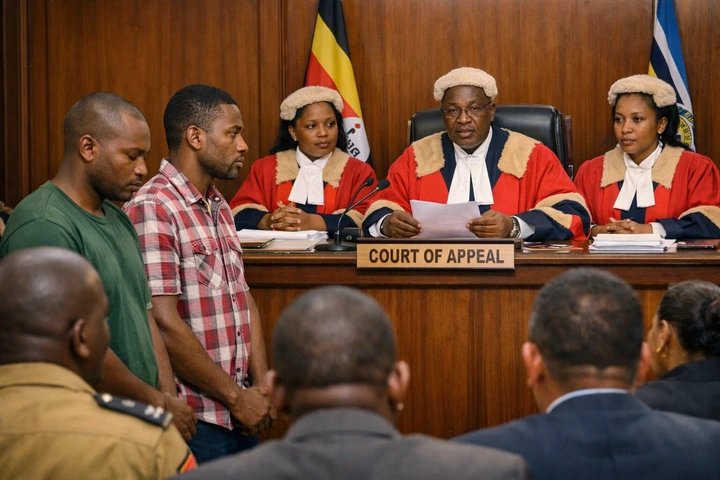
Aggrieved, they appealed the decision in the Court of Appeal. The case was heard by a panel of judges that included: Justice Hellen Abura, Justice Asa Mugenyi, and Justice Stella Alibateese.
Their lawyer, Julian Nyaketcho, argued that the conviction was unsafe because it was based on speculation rather than proof.
She told the court that none of the prosecution witnesses directly linked the accused to the killing and that key gaps in the evidence had been ignored.
She pointed out that the prosecution’s own witness, identified as PW4, was the last person seen with Nyamagambo and not the accused persons.
She also challenged the claim that Nyamagambo went to the home of Magezi, saying there was no evidence to support that finding.
On the other hand, the state attorney, Robert Arinatwe, defended the conviction.
He told the panel of judges that the High Court had properly applied the “last seen†doctrine, which allows a court to infer that the person last seen with a deceased person may be responsible for their death if no explanation is given.
In the High Court, the prosecution relied heavily on the testimony of a witness who said the deceased left her home after being called by Byaruhanga for sexual intercourse and was never seen again.
After hearing the case, the Court of Appeal found serious problems with that argument, stressing that it had a duty to reconsider all the evidence afresh.
The judges agreed that Nyamagambo had indeed died and that she was unlawfully killed. They also accepted that whoever killed her acted with malice aforethought.
However, they said the key issue was whether Byaruhanga and Magezi actually participated in the crime.
The judges emphasised that in cases based on circumstantial evidence, the law requires a very high standard of proof.
They warned that courts must be careful not to convict where there are “co-existing circumstances which weaken or destroy the inference of guilt.â€
Applying that test, the court found that the evidence against Byaruhanga and Magezi did not pass the required threshold.
One major weakness, they argued, was that the “last seen†theory relied on by the prosecution. The court noted that, if applied strictly, the last person seen with the deceased was actually the prosecution witness PW4, not the accused.
“Thus, what transpired between the time PW4 left the deceased at her home around 10:00 p.m. and the time of her death remains speculative,†the judges said.
They also pointed out that the exact time of death was never established, making it impossible to place the accused at the scene of the crime at the critical moment.
The judges further criticised contradictions in the prosecution’s case, especially regarding the allegation of rape. It noted that if the deceased had willingly gone to meet Byaruhanga, the prosecution needed to explain how the encounter turned into rape.
“Such inconsistencies create co-existing circumstances that weaken or destroy the inference of guilt,†they argued.
Another major gap was the lack of forensic evidence. The court observed that no DNA or scientific evidence was presented to link the accused to the crime.
It also found no evidence connecting Magezi to the murder beyond the fact that he lived nearby.
The judges were very critical of the High Court’s reasoning, saying it relied on speculation rather than proof.
The judges reminded the lower court that criminal cases require proof beyond a reasonable doubt, not mere suspicion or possibility. They concluded that the prosecution had failed to prove its case.
“The evidence is insufficient to establish the appellants’ participation in the murder,†the judges ruled.
They allowed the appeal, quashed the convictions, and ordered that the two men be released.
Despite spending more than 10 years in detention, Byaruhanga and Magezi were not awarded any financial compensation because this was a criminal appeal focused purely on conviction and sentence rather than damages.


 Government will not gazette Kijanangoma as King of Tooro for now - Attorney General insists
Ultimate Uganda
Government will not gazette Kijanangoma as King of Tooro for now - Attorney General insists
Ultimate Uganda
 King Oyo’s Body to Arrive Thursday
Ultimate Uganda
King Oyo’s Body to Arrive Thursday
Ultimate Uganda
 Besigye, Lukwago expected to meet Gen. Salim Saleh today at Kapeeke
Ultimate Uganda
Besigye, Lukwago expected to meet Gen. Salim Saleh today at Kapeeke
Ultimate Uganda
 Rwabwogo Advised to ‘Eat His Bishop’ As MK Prepares to Enter State H’se: PREZ MUSEVENI ON HIS WAY OUT
Ultimate Uganda
Rwabwogo Advised to ‘Eat His Bishop’ As MK Prepares to Enter State H’se: PREZ MUSEVENI ON HIS WAY OUT
Ultimate Uganda
0 Comments