
Salary Increment Promise: Museveni Breaks RDCs’ Hearts (See Details)
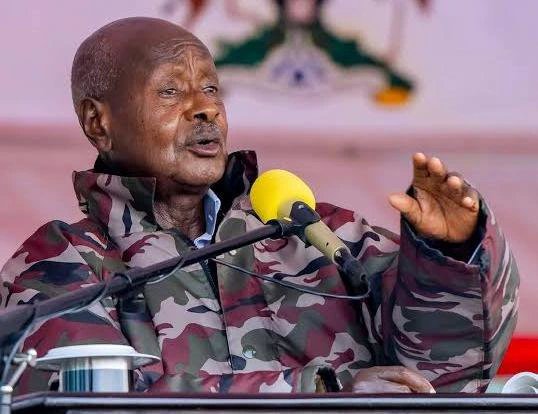

Museveni
KAMPALA, Uganda — For months, Resident District Commissioners (RDCs), their deputies and assistants across Uganda had looked forward to what many considered a long-overdue reward: a substantial salary enhancement that government officials and parliamentary committees had publicly discussed as a correction to nearly two decades of stagnant pay. Last week, however, that anticipation gave way to disappointment, sources have told The Pearl Times.
Addressing RDCs, District Internal Security Officers (DISOs), Resident City Commissioners (RCCs), deputy RDCs, deputy RCCs, assistant RDCs and assistant RCCs from Buganda at Collin Hotel in Mukondo, sources that were in the meeting further told us, Hajji Yunus Kakande, the Permanent Secretary in the Office of the President, delivered a message many in attendance had not expected.
The government, he reportedly said, had chosen to prioritize salary enhancements for arts and humanities teachers in the coming financial year beginning July 1. RDCs and their counterparts, despite expectations of a pay rise, would have to wait.
According to participants at the meeting, Kakande explained that those serving as presidential representatives should remain patient and patriotic, adding that salary enhancement for RDCs could instead be considered in 2027.
The announcement effectively postpones one of the most ambitious salary review proposals ever tabled for Uganda’s presidential representatives.
Just weeks earlier, Parliament’s Presidential Affairs Committee had backed a proposal that would have dramatically increased the earnings of RDCs and related officials. Under the plan, RDC salaries were expected to rise from about Shs2.29 million to Shs9 million per month.
Deputy RDCs would move from roughly Shs1.28 million to Shs5 million, while assistant RDCs would see their salaries increase from about Shs877,216 to approximately Shs2.69 million. The proposal was presented as a response to nearly 20 years without a significant salary review.
The figures, another source further The Pearl Times, will be much higher than what has been reported when the increment is finally effected. An RDC, the source continued, could pocket over Shs10m every month.
For many RDCs, the prospect of such an increase had generated hope that government was finally recognizing the expanding responsibilities attached to the office.
RDCs occupy a unique position within Uganda’s governance structure. Appointed by the President, they serve as the government’s representatives at district level and are charged with monitoring public service delivery, coordinating security matters, mobilizing citizens for government programs and overseeing the implementation of national policies.
Over the years, their responsibilities have steadily expanded.
In addition to chairing district security committees, RDCs have increasingly become the public face of government initiatives ranging from Parish Development Model implementation to Emyooga, agricultural modernization campaigns and wealth-creation programs.
At the Buganda meeting, Kakande reinforced that expectation. He urged RDCs to intensify efforts in mobilizing citizens into production and ensuring communities embrace government poverty-alleviation programs.
The message reflected President Yoweri Museveni’s long-standing belief that economic transformation begins at household level and that local government representatives should serve as frontline mobilizers.
Yet the postponement of the salary review underscores the difficult choices confronting government as competing sectors seek limited public resources.
This year’s budget process has been dominated by demands from teachers, particularly arts and humanities educators who have spent years protesting what they viewed as discriminatory salary structures that favored science teachers.
The government eventually allocated funds to raise the salaries of arts teachers and primary school teachers beginning in the 2026/27 financial year. The enhancement amounts to roughly 25 percent for affected categories. Degree-holding arts teachers in secondary schools are expected to see monthly salaries rise from about Shs960,288 to over Shs1.2 million, while primary teachers will also receive significant increases.
That decision appears to have pushed RDC salary enhancements down the priority list.
The development is likely to reignite debate about the place of RDCs within Uganda’s governance architecture.
Supporters argue that RDCs are essential to maintaining government presence in every district, coordinating security and ensuring accountability among local officials. They contend that the officials often operate with limited resources despite carrying heavy responsibilities and political expectations.
Critics, however, have long questioned both the cost and role of RDC offices.
Opposition politicians and governance activists have repeatedly accused some RDCs of interfering in electoral processes, intimidating political opponents and exceeding their constitutional mandates. During election seasons, RDCs frequently find themselves at the center of disputes involving rallies, public meetings and political mobilization.
Human rights organizations have also occasionally accused certain RDCs of using security agencies to suppress dissent, allegations government officials routinely reject.
The controversy has made RDCs among the most visible and politically sensitive public servants in Uganda.
Their defenders argue that the criticism often ignores the difficult environment in which they operate.
Many RDCs serve in remote districts where they must respond to security incidents, mediate local conflicts and supervise implementation of numerous government programs. Several have argued that their current salaries do not reflect either the demands of the job or inflationary realities.
That argument appeared to resonate with Parliament’s Presidential Affairs Committee earlier this year.
Committee members noted that while many categories of public servants have benefited from salary enhancements over the years, RDCs and their deputies have largely remained on the same pay scale for almost two decades.
For now, however, the promised salary boost remains out of reach.
The postponement leaves hundreds of RDCs, deputy RDCs and assistant RDCs facing another year under the existing salary structure while government focuses on other priorities.
Whether the promised enhancement materializes in 2027 may depend on economic conditions, political calculations and the government’s ability to balance competing demands from public servants across multiple sectors.
For officials who gathered at Collin Hotel expecting encouraging news about their welfare, the message was clear: patriotism, at least for another year, will have to substitute for a pay raise.
As Uganda enters a new financial year marked by ambitious development targets and growing expectations from various public sector workers, RDCs find themselves in a familiar position—asked to deliver government programs, mobilize communities and represent the President in every corner of the country, while waiting a little longer for the salary increase many believed was finally within reach.
See the current list of RDCs, deputy RDCs and assistant RDCs as well as salary for each HERE.
Regarding arts and primary teachers, you can read about their salary increment and figures Here and There.
The current salary structure showing how much each government employee category earns is HERE.


 Government will not gazette Kijanangoma as King of Tooro for now - Attorney General insists
Ultimate Uganda
Government will not gazette Kijanangoma as King of Tooro for now - Attorney General insists
Ultimate Uganda
 King Oyo’s Body to Arrive Thursday
Ultimate Uganda
King Oyo’s Body to Arrive Thursday
Ultimate Uganda
 Besigye, Lukwago expected to meet Gen. Salim Saleh today at Kapeeke
Ultimate Uganda
Besigye, Lukwago expected to meet Gen. Salim Saleh today at Kapeeke
Ultimate Uganda
 Rwabwogo Advised to ‘Eat His Bishop’ As MK Prepares to Enter State H’se: PREZ MUSEVENI ON HIS WAY OUT
Ultimate Uganda
Rwabwogo Advised to ‘Eat His Bishop’ As MK Prepares to Enter State H’se: PREZ MUSEVENI ON HIS WAY OUT
Ultimate Uganda
0 Comments