
Speaker budget grows seven times over six years
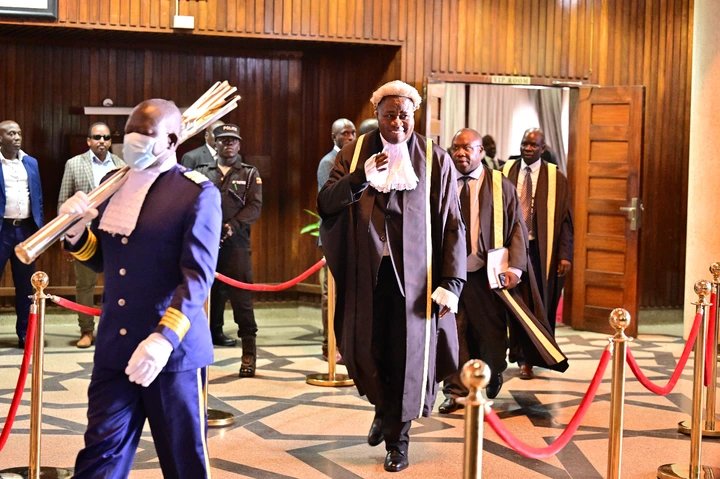

Parliament Speaker Jacob Marksons Oboth (2nd right) leaves Parliament chambers after presiding over plenary session on May 28, 2026. PHOTO/ PARLIAMENT OF UGANDA X HANDLE
The budget of Parliament has within six years doubled to Shs1.2 trillion, despite the number of elected members of the House remaining constant at 529 within the same period. Our analysis shows the budgets for the Speaker, who is the administrative head of the Legislature, and the Deputy, have increased by about 7 and 8-fold, respectively. There was, however, a modest rise by roughly Shs1 billion in allocations to the Offices of the Leader of Government Business and that of the Leaders of Opposition in Parliament (LoP). The 10th Parliament had a total 443 elected MPs and 16 ex-officio members appointed to the Cabinet by the President, making a total of 459 members. However, ahead of the 2021 elections, 86 new constituencies were created, taking the total number of elected legislators to 529, increasing the burden on the Treasury to cater for the additional numbers.
Officials, including Mr Chris Obore, the spokesperson of Parliament, which is undergoing a leadership transition following the May 24 inauguration of the 12th Parliament, were unavailable to explain the reasons for the substantial increase in spending by the people’s representatives. The Parliamentary Building is currently undergoing expansion at Shs220 billion to add space to seat the current total of 555 MPs, including ex-officios, with LoP Joel Ssenyoni last week questioning why the engineering works have stalled despite yearly allocations to fast-track it. These budgetary revelations come to light following months of scrutiny of the financial behaviour of the Legislature, and only weeks after the Speaker of the 11th Parliament Anita Annet Among, under whom the multi-billion increase in allocations happened, was placed under formal inquiry for alleged illicit enrichment, corruption and abuse of office.
A social media exhibition by Agora Discourse, a digital public forum, raised queries over expenditure of taxpayers’ money by the 11th Parliament, with several billions of shillings passed from the House coffers through private bank accounts of its employees close to the former Speaker, Ms Anita Among. The money was reportedly spent mainly on donations. The Agora activists last week published a list of more than 150 staff that it said Parliament recruited during Ms Among’s tenure, allegedly without formal advertising, thereby bulging the budget of personnel amid near-tripled departments headed by directors. According to the estimated revenue and expenditure blueprint of Parliament, which will be included in the National Budget to be presented next week, Shs744b will be spent on the 529 MPs, nearly double the Shs400b allocated to them in the 2020/2021 Financial Year, indicating rising cost of democracy.
The allocations for the other two arms of the government - the Executive and Judiciary - have similarly increased substantially, with the former taking a lion’s share funded through direct allocations and supplementary, which raise questions about public sector financial discipline. The Speaker and Deputy of the 12th Parliament will have a combined Shs50.2 billion to run their respective offices, for the second year running. The Speaker will take Shs28.5 billion while his Deputy will spend Shs21.7 billion, up from Shs19 billion for the Speaker and Shs14.5 billion for the Deputy in the 2024/2025 Financial Year. The Office of the Leader of Government Business will get Shs5.2 billion, while that of the Leader of the Opposition in Parliament will get Shs4.2 billion. When broken down, the Speaker spends daily Shs78.2 million, while the Deputy spends daily Shs59.4 million to run their respective offices.
Details of the breakdown of how the funds for the 2026/2027 Financial Year will be spent have been kept away from the approved budget documents. However, the 2025/2026 Financial Year approved budget indicates the Speaker spent Shs950 million on inland travels while Shs2.4 billion was spent on travel abroad. The Speaker also spent Shs966 million on fuel, lubricants and oils, while Shs648 million was spent on maintenance of transport equipment. Another Shs4.8 billion was spent on incapacity, death benefits and funeral expenses and a further Shs5.42 was allocated for Speaker’s donations. It is the hefty donations and other expenditures that have drawn the attention of a number of legislators, who are demanding that the budget for the Speaker, the Deputy and other elected leaders within the Parliament be downsized.
Burden of Speakers on taxpayers In the 2020/2021 Financial Year, the last year when Speaker of the 10th Parliament, Ms Rebecca Alitwala Kadaga, presided over the House, the Office of the Speaker operated a budget of Shs4.4 billion, while the Deputy had a budget of Shs2.7 billion. The budget for the Leader of Opposition in Parliament in the 2020/2021 Financial Year was even bigger than that of the Deputy Speaker at the time, standing at Shs4.2 billion against Shs2.7 for the Deputy Speaker, while that of the Leader of Government Business in Parliament stood at Shs1.4 billion. In the 2021/202022 Financial Year, when Oulanyah was elected Speaker and Anita Among became Deputy, the budget for the Speaker came down to Shs3.9 billion, while that of the Deputy Speaker was increased to Shs2.9 billion.
While the total budget for MPs stood at Shs400 billion at the time Speaker Kadaga left, Speaker Oulanyah’s brief stay at the helm saw the figures only increase by an additional Shs35,2 billion to cater for the additional 86 MPs. But in the four years Speaker Among was in charge, the figures have since shot up to Shs744 billion for the same number of MPs, with no explanation given for the steep rise. At the time, in the 2021/2022 Financial Year, the Leader of Opposition had a budget of Shs3 billion, while the Leader of Government Business had Shs1.4 billion. It was during the 2022/2023 Financial Year when Speaker Among took full control of the House, deputised by Mr Thomas Tayebwa that the budget for the Speaker and that of the Deputy started rising sharply.
For example, the budget for the Speaker rose from Shs3.9 billion during the late Oulanyah’s short stay to Shs8.2 billion, while that of the Deputy rose from Shs2.9 billion to Shs7.1 billion. With a total budget of Shs915 billion, the MPs got Shs510 billion, the Leader of the Opposition in Parliament got Shs4.5 billion, while the Leader of Government Business had no variation in the Shs1.4b budget as was allocated in the previous year. In the 2023/2024 Financial Year, the budget for the Speaker shot up from Shs8.2 billion to Shs13.7 billion, while that of the Deputy increased from Shs7.1 billion to Shs10.7 billion.
The Leader of the Opposition in Parliament had a cut by Shs300 million while the Leader of Government Business in Parliament got Shs3.7 billion, and Shs544 billion went to the MPs. The FY 2024/2025 saw another sharp increase in the budget for the Speaker and Deputy, with the Speaker getting Shs19 billion, while the Deputy took away Shs14.5 billion. Out of the total Shs977.8 billion, Shs576.9 billion was apportioned to MPs salaries and emoluments, while the Leader of the Opposition in Parliament got Shs4.2 billion and that of the Leader of Government Business had Shs3.7 billion.
Total Parliament budget
The 2026/2027 financial year budget of Parliament stands at Shs1.2 trillion, with Shs744.4 billion going to the MPs, and more than Shs60 billion distributed between the Speaker, the Deputy, Leader of Government Business and the Leader of the Opposition in Parliament. The 2026/2027 budget is double the budget Speaker Kadaga had in her final year that stood at Shs672.8 billion during the 2020/2021 financial year. Is the parliamentary commission complicit in inflating the budget?
Parliamentary Commission
Article 87A of the Constitution and Section 2(2) of the Administration of Parliament Act provide for the creation of the Parliamentary Commission, which is the principal governing body of the Parliament of Uganda. It is responsible for administration of the Legislature and the welfare of its members and employees and, among others, hires and fires staff and determines their terms of service. The Commission comprises nine members who include the Speaker (Chairperson), the Deputy, the Leader of Government Business (or the Prime Minister), the Leader of the Opposition, and the Minister of Finance. There are also four backbench members, with three from the ruling NRM party, and one from the official opposition party in Parliament.
The Commission, chaired by the Speaker, has recently come under scrutiny over what many called wasteful expenditure. For example, the back-bench commissioners in 2024 awarded themselves a Shs1.7 billion service award, which drew sharp criticism from the public. Ms Among recently dropped out of the race for Speaker of the 12th Parliament after she publicly indicated she would not be presenting herself for the position. Her decision followed a State House meeting in which the President reportedly advised her against contesting. She has since been replaced by Jacob Marksons Oboth, who was elected on May 25, and deputised by Thomas Tayebwa, who bounced back as Deputy Speaker.
What others say
Ms Among’s homes in Kampala and Kigo, off the Kampala-Entebbe Expressway in Wakiso District, and in Bukedea District, have been raided by security forces over allegations of a lavish lifestyle, illicit enrichment, and corruption. Ms Florence Asiimwe Akiiki, the Masindi District Woman MP told this publication that the Speakers cannot spend taxpayers’ money as if they are fetching water from the lake. “That money should be cut completely. We are not going to have that lavish lifestyle. The budget for the Speaker should be cut. We need to decide how many cars the Speaker should have. Can you imagine 13 cars? A Speaker having 13 cars,†she wondered.
Ms Asiimwe also took issue with the budget for donations and wondered why the Speaker should become a donor using taxpayers’ money. She said while drawing the budget, the relevant committees should look at the practice in other poor nations across the continent before allocating the Speaker hefty sums of money. Mr Jackson Kafuuzi, the Kyaaka County MP, said the 11th Parliament lost credibility because of the way the leaders conducted themselves. “I have been in Parliament for 10 years.
Before the 2021 elections, I saw how Parliament was chaired… But lately, from 2021 onwards, a number of things have gone sideways, especially in regard to chairing the committee of the whole House of Parliament. I want to work with my colleagues to improve the performance of Parliament,†he said. “In as far as the legislation is concerned, the outlook, the presentation, the demeanour, and the image we have given to the public is lacking. We need to work towards rebuilding that image,†he added.
Restore public confidence
Mr Patrick Ogwang Obura, the Oyam County South MP, said now is the time to get a leader who will restore public confidence and trust in the Parliament that is supposed to represent them. “We come to show solidarity with Ugandans that we, the young people, cannot sit back and watch a Parliament of Uganda that has questionable reputation, where the public has lost confidence,†he said.


 Government will not gazette Kijanangoma as King of Tooro for now - Attorney General insists
Ultimate Uganda
Government will not gazette Kijanangoma as King of Tooro for now - Attorney General insists
Ultimate Uganda
 King Oyo’s Body to Arrive Thursday
Ultimate Uganda
King Oyo’s Body to Arrive Thursday
Ultimate Uganda
 Besigye, Lukwago expected to meet Gen. Salim Saleh today at Kapeeke
Ultimate Uganda
Besigye, Lukwago expected to meet Gen. Salim Saleh today at Kapeeke
Ultimate Uganda
 Rwabwogo Advised to ‘Eat His Bishop’ As MK Prepares to Enter State H’se: PREZ MUSEVENI ON HIS WAY OUT
Ultimate Uganda
Rwabwogo Advised to ‘Eat His Bishop’ As MK Prepares to Enter State H’se: PREZ MUSEVENI ON HIS WAY OUT
Ultimate Uganda
0 Comments