
Everybody hates you now. Everybody hates Israel because of this.â€
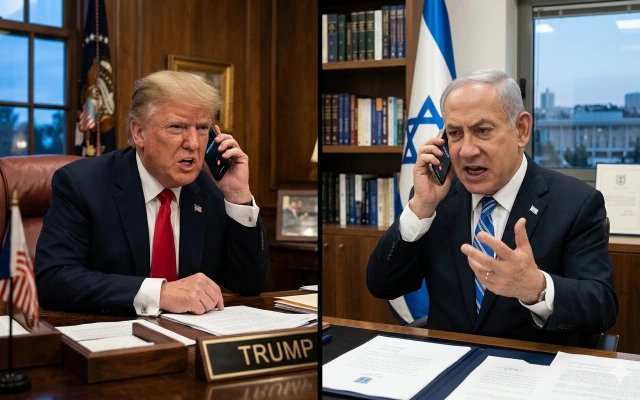

Axios’s account of an expletive-laden phone call between President Trump and Prime Minister Netanyahu has landed at a fraught moment. According to a U.S. official’s summary cited by Axios, Trump told Netanyahu: “You’re fucking crazy. You’d be in prison if it weren’t for me. I’m saving your ass. Everybody hates you now. Everybody hates Israel because of this.†A second official said Trump at one point shouted, “What the fuck are you doing?â€
These are reportedly not paraphrases. They are the words of a sitting American president to his closest regional ally, on a call that one U.S. official described as among Trump’s worst with Netanyahu since returning to office. Whether the language is the product of a private temper flare or deliberate theatrical signaling, the effect is the same: it exposes a widening structural gap between two leaders whose domestic pressures are now pulling in opposite directions. At stake is more than rhetoric. The dispute sits atop a cluster of linked crises — Gaza, Lebanon, and the Iran confrontation — and arrived on a day of acute political vulnerability in Israel. The words matter because the incentives behind them matter even more.
The Reporting and Its Ambiguity
The call invites two immediate readings. On one hand, Trump’s language can be read as a spontaneous expression of anger at a partner he believes is undermining a diplomatic track — specifically, his negotiations with Iran, which Netanyahu’s Lebanon escalation was threatening to derail. Iran had already announced it was suspending those talks over Israel’s actions in Lebanon on the same day. On the other hand, the same language can be read as a public signal intended for third parties — Tehran, regional capitals, domestic audiences — designed to shape perceptions about who controls escalation.
The two readings are not mutually exclusive. A single outburst can be both catharsis and choreography. Notably, the call produced a concrete result: Israel apparently abandoned its plans to strike Hezbollah targets in Beirut. One U.S. official told Axios that Trump had “steamrolled†Netanyahu, with Netanyahu reportedly responding, “OK, OK, just make sure everything is taken care of.†Trump then posted on Truth Social thanking Netanyahu for turning his troops around and announcing a Hezbollah ceasefire — projecting a constructive outcome from a privately brutal exchange.
Diverging Domestic Constraints
What makes the exchange consequential is not only what was said but why it matters now. Both leaders face pressing domestic political constraints that shape their incentives, and those constraints are pointed in opposite directions.
In Washington, the closure of Hormuz and spike in oil prices have had immediate domestic consequences; The Iran nuclear negotiations represent Trump’s off ramp from an unpopular war in the run up to the November midterms. Netanyahu’s Lebanon escalation threatened to collapse Trump’s agenda for his second term.
In Jerusalem, the political calculus is different and, in some respects, more existential — and it has now become dramatically more urgent. On the morning of the call, the Knesset House Committee voted 8-0 to advance a dissolution bill to the full parliament for its first reading, the latest step in a process that began May 20 when 110 of 120 lawmakers backed a preliminary dissolution measure. Elections — which had been scheduled for October — could now come as early as September, a timeline Netanyahu has privately warned would “endanger†the right-wing bloc’s chances of winning. The trigger was a rupture over legislation to exempt ultra-Orthodox men from mandatory military service, but the deeper cause is the accumulated political cost of the October 7 security failure, for which Netanyahu’s coalition has never been held accountable at the ballot box.
The Meaning of “Total Victoryâ€
It is in this context that the phrase “total victory†must be understood — not as a slogan but as a substantive political commitment with a specific content. For Netanyahu’s hard-right coalition partners, Finance Minister Bezalel Smotrich and National Security Minister Itamar Ben-Gvir, “total victory†has always meant something more than weakening Iran, its proxies and nuclear ambitions. It has meant the unequivocal elimination of the Iranian regime as an organizing force in the region — the view that Iran is an existential evil whose removal is a precondition for any durable Israeli security. In this worldview, dismantling Iran’s nuclear and ballistic missile capabilities is not the endpoint; it is just the most immediate benefit of regime change. Netanyahu has fed this logic consistently. After the June 2025 Twelve-Day War, he heralded a “historic victory†that would “stand for generations,†appeared on an Iranian opposition television program called “Regime Change in Iran,†and told reporters: “This is a very weak regime that now understands how weak it is… we could see many changes in Iran.†His former national security adviser called the moment “a golden opportunity to change the direction of the whole Middle East.â€
This is precisely where U.S. and Israeli objectives diverge most sharply. The White House has supported eliminating Iran’s nuclear and ballistic missile capabilities but — rhetoric aside — has generally opposed a broader mission to reshape Iran by force. As one senior U.S. official put it: “They might be more comfortable with regime change than we are. They may be more comfortable with destroying the country than we are.†For Netanyahu’s coalition, any outcome short of regime change is, by definition, incomplete — which means any ceasefire or negotiated framework that leaves the Islamic Republic intact is politically unsellable to the partners on whose votes his government depends. Trump’s demand for restraint collides directly with the internal logic of Netanyahu’s coalition survival.
Gaza as the Center of Gravity
All of these dynamics circle back to Gaza. Gaza is the moral and political center of gravity for the region: it drives international outrage, shapes Arab public opinion, and is the locus of the security failure that has hollowed out political legitimacy in Israel. Lebanon and the Hormuz threat are not separate problems but extensions of the same unresolved core. The hard right’s refusal to accept any outcome short of total victory — defined as the elimination of Iran’s capacity and ultimately its regime — is inseparable from the original promise made after October 7. For the U.S., the immediate worry is the economic fallout of a wider regional conflagration; for Netanyahu’s coalition, the immediate worry is the political cost of admitting that the war has ended without fulfilling the promise that justified it.
Conclusion
The profanity and personal admonishment that have made headlines are less important than what they reveal: a structural divergence between two leaders whose domestic imperatives now conflict at a dangerous moment. One leader must protect a diplomatic legacy and avoid economic shocks; the other must sustain a coalition whose definition of victory — the end of the Iranian regime as an existential threat to Israel — is one that no negotiated settlement is likely to satisfy. That divergence, not the sharp words themselves, is the strategic risk.
At a critical junction where Gaza’s unresolved catastrophe, a government that may face voters in September, and Hormuz’s economic leverage are tightly coupled, rhetoric becomes a vector for escalation. The immediate task for analysts and policymakers is to read the words as signals of incentives — and to understand that for Netanyahu’s hard right, “total victory†was never a slogan. It was a promise about the Iranian regime’s demise, one that the current diplomatic track is designed to foreclose.


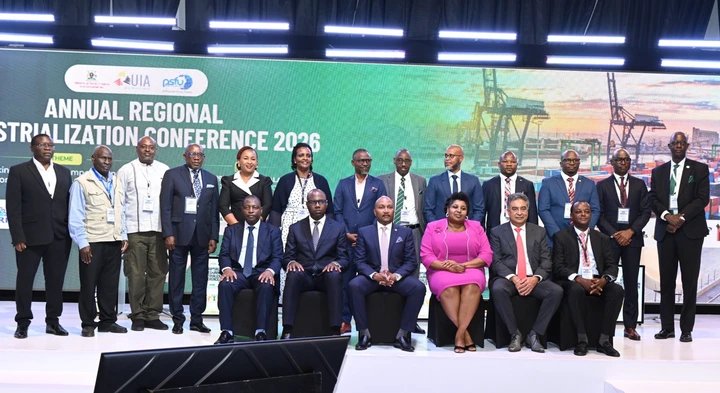 DRC opposition urges Tshisekedi to abandon constitutional changes
Ultimate Uganda
DRC opposition urges Tshisekedi to abandon constitutional changes
Ultimate Uganda
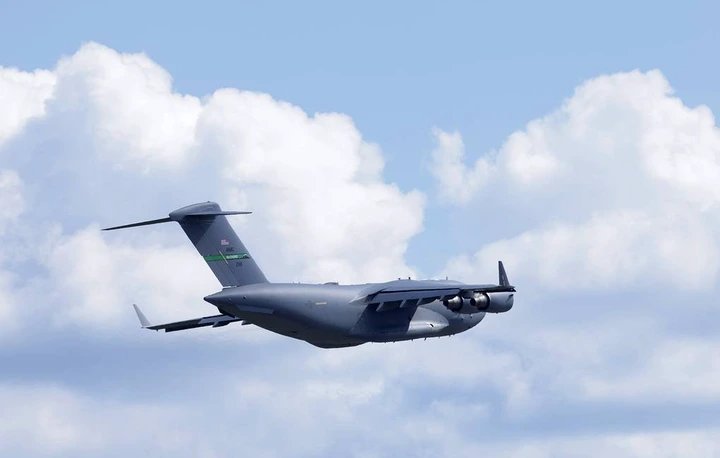 US military transport plane lands in Moscow
Ultimate Uganda
US military transport plane lands in Moscow
Ultimate Uganda
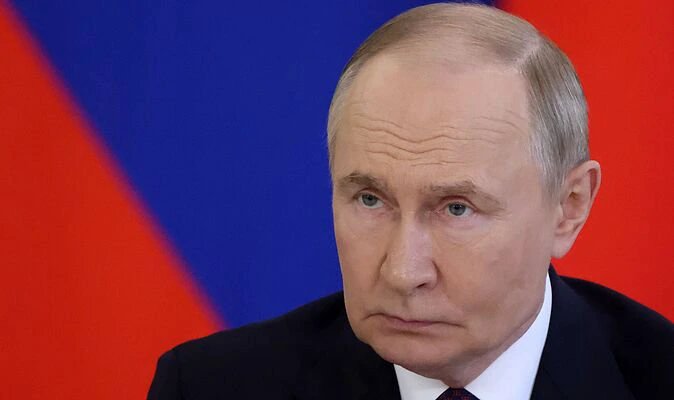 Putin puppet slaps UK with terrifying 2-word warning over drone factories
Ultimate Uganda
Putin puppet slaps UK with terrifying 2-word warning over drone factories
Ultimate Uganda
 China develops hypersonic weapon to hunt US command aircraft thousands of miles away
Ultimate Uganda
China develops hypersonic weapon to hunt US command aircraft thousands of miles away
Ultimate Uganda
0 Comments