
Allan Kasujja and PR Guru Kyamutetera Clash Over Uganda Media Centre’s One-Liner Press Releases
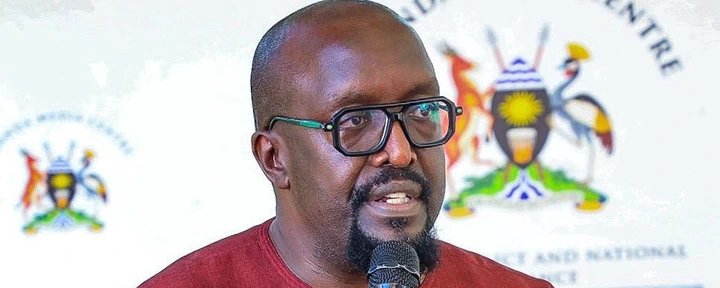

Kampala, Uganda — A spirited online exchange between Uganda Media Centre Executive Director Alan Kasujja and renowned public relations expert Muhereza Kyamutetera has ignited a national debate over the government’s emerging communication style, which favors ultra-brief press releases.
The discussion was triggered by a notably concise statement issued by the Uganda Media Centre on May 18, 2026, confirming that June 3 would remain a public holiday to commemorate Martyrs’ Day, despite the postponement of pilgrimages to Namugongo due to Ebola concerns linked to neighboring Democratic Republic of Congo.
The release, which consisted of little more than a single sentence, quickly attracted both praise and criticism from communication professionals, journalists, and members of the public.
The Exchange
Muhereza Kyamutetera, Executive Editor of CEO East Africa Magazine and a respected communications practitioner, publicly questioned the effectiveness of the minimalist approach. In a detailed commentary, he argued that such brief statements risk sacrificing professionalism by omitting critical context, official quotes, background information, and details that are often necessary for journalists, investors, diplomats, and the wider public.
Responding on X (formerly Twitter), Alan Kasujja rejected the criticism, suggesting that observers were rushing to judgment before seeing the broader strategy behind the communication shift.
“You are being presumptuous my guy. You haven’t seen our blueprint. Relax and let’s work,†Kasujja wrote.
His response quickly gained traction online, fueling further discussion about the future of government communications in Uganda.
Supporters and Critics Weigh In
The new format has found supporters among several prominent public figures who believe it reflects the realities of modern communication.
Comedian Patrick Salvado and broadcaster Samson Kasumba have reportedly welcomed the concise style, arguing that short, direct messages are more effective in capturing public attention on social media platforms and reducing information overload.
Critics, however, remain unconvinced. Broadcaster Simon Kaggwa Njala and other commentators argue that oversimplified communication may undermine Uganda’s image among serious stakeholders who require comprehensive and authoritative information.
Among the proposals emerging from the debate are the inclusion of QR codes linking to detailed statements and the adoption of a hybrid communication model that combines brief announcements with easily accessible background information.
A New Direction for Government Communication
Kasujja assumed leadership of the Uganda Media Centre in March 2026 with a mandate to modernize government communication and enhance Uganda’s image both locally and internationally.
A veteran journalist and former BBC presenter, he has been widely expected to introduce innovative communication approaches. The early emphasis on brevity appears to be one of those innovations, although it has already generated considerable discussion within media and public relations circles.
The Bigger Question
Beyond the personalities involved, the debate highlights a broader challenge facing governments and institutions worldwide: how to communicate effectively in an era of shrinking attention spans without compromising accuracy, context, and credibility.
As discussions continue across social media platforms and professional forums, many observers are waiting for the Uganda Media Centre to unveil the comprehensive communication “blueprint†referenced by Kasujja.
Until then, the controversy surrounding the one-line press release serves as a timely reminder that in modern communication, the balance between brevity and substance remains a delicate one


 The women who have been in King Oyo’s life
Ultimate Uganda
The women who have been in King Oyo’s life
Ultimate Uganda
 Ex Kagame Guard Commander Tom Byabagamba Dies in Rwandan Prison After 12 Years
Ultimate Uganda
Ex Kagame Guard Commander Tom Byabagamba Dies in Rwandan Prison After 12 Years
Ultimate Uganda
 Government begins salary payments for public sector workers – Reform Committee
Ultimate Uganda
Government begins salary payments for public sector workers – Reform Committee
Ultimate Uganda
 Temangalo land: NSSF, Nzenyi reach agreement
Ultimate Uganda
Temangalo land: NSSF, Nzenyi reach agreement
Ultimate Uganda
0 Comments