
Prolonged Dry Spell Devastates Crops, Sparks Hunger Fears in Teso
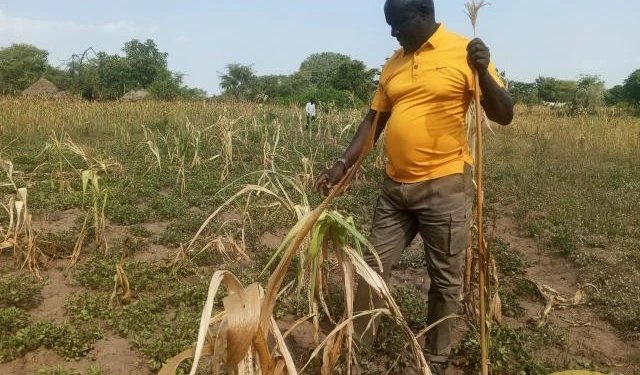

An unusually prolonged dry spell has devastated first-season crops across Teso Sub-region, raising fears of widespread food insecurity as farmers, local leaders and agricultural officials warn that thousands of households could face hunger after suffering massive crop losses. The prolonged drought, which began around mid-May and has now stretched for more than a month, has disrupted the region’s traditional farming calendar.
Teso, whose agriculture largely depends on rain-fed farming, normally experiences two rainy seasons with the first beginning around March and extending to June before a short dry spell. However, this year’s dry conditions arrived much earlier than expected, destroying crops that communities rely on for food and income. For many households, the first growing season is the most important because it provides food harvested between July and August, while the second season mainly supplements household food stocks.
The failure of the first season therefore leaves families vulnerable to hunger before the next planting season. Amuria NRM chairperson and former State Minister for Works, Musa Francis Ecweru, described the situation as unprecedented, saying communities across Teso have suffered near-total crop failure. He said the region traditionally plants such as sorghum, millet, maize, groundnuts, beans and green gram between February and April, expecting a brief dry spell in June before rains resume. “This year, the short dry spell turned into an outright drought,†Ecweru said.
According to him, reports from farmers and production officers indicate that 99 per cent of crops have been lost in many parts of the region. He said sorghum, millet, maize, groundnuts and beans have all dried up before maturity, while even cassava, usually considered a fallback crop during difficult seasons, is now rotting because of the prolonged heat. “Teso depends almost entirely on seasonal crops. Apart from cassava, we do not have widespread perennial crops such as bananas that can cushion households during failed seasons,†he said.
Ecweru warned that unless reliable rains return before the end of July and farmers are supported with quick-maturing seed varieties for the second planting season, food insecurity will worsen across the region. He appealed to the government and the Ministry of Agriculture to urgently assess the situation in Amuria, Ngora, Katakwi, Kumi, Bukedea, Kapelebyong and neighbouring districts, saying similar conditions have also been reported in parts of Lango, including Otuke.
“The issue should be treated as a matter of national importance because food security is no longer guaranteed,†he said. He also urged Parliament to raise the matter urgently and asked the government to support farmers with fast-maturing varieties of sorghum, millet, sweet potatoes and other crops once the rains return. Ecweru further called for increased investment in irrigation, saying reliance on rain-fed agriculture has left communities highly vulnerable to increasingly unpredictable weather patterns.
Across Angole Village in Wera Sub-county, farmers narrated how promising crops withered after the rains stopped. Omoding Wilfred said the season had started well before the prolonged dry spell destroyed nearly everything planted. “The rains disappeared in mid-May, and I have lost maize, millet, sorghum, groundnuts, beans and many other crops,†he said.
Wilfred appealed to the government to provide early maturing seed varieties once rains resume, saying many families now have no food reserves. “We are likely to face hunger because what we depended on as our food basket has been destroyed,†he said. Another farmer, Musa Akulau, said the drought wiped out crops planted on more than 10 acres of land.
“We depended on farming to pay school fees and support our families, but now there is nowhere to get money,†he said, appealing for cassava planting materials to help farmers recover. Similarly, Odulai Edison said farmers attempted to replant after the first rains failed but the second attempt also dried up. “We replanted groundnuts, cassava and sorghum but everything dried up. There is nothing left in the gardens,†he said.He warned that the losses would likely force many children out of school because families depend on crop sales to pay tuition. “There is nothing to sell. Even livestock are suffering because wetlands have dried up and there is little water for animals,†Edison said. Wera Town Council Agricultural Officer Opio Geoffrey said preliminary assessments show that the drought has affected between 80 and 85 per cent of farming households in Wera Sub-county.
He said the sub-county has about 2,350 households, of which approximately 2,150 depend on farming. Although data collection is still ongoing, he said the impact has been severe, particularly for maize, groundnuts and other staple crops. “Maize at the tasselling stage has been severely affected because prolonged dry conditions reduce soil moisture, preventing proper grain formation,†he said.
Groundnuts at the podding stage have also suffered significant damage alongside other cereals and legumes. Opio explained that farmers who planted immediately after the early rains in February managed to harvest some crops after following weather advisories issued by agricultural extension workers.
However, many farmers delayed planting, expecting the usual March rains, and were caught off guard by the unusual weather pattern. The agricultural officer said food availability has already started declining in many households.
Field assessments indicate that many families are now eating fewer than two meals a day while the quality of diets has also deteriorated because households have limited food options. He warned that if the dry spell projected to continue into late July persists, many families will face severe food insecurity due to poor harvests and declining household incomes.
Some crops, including groundnuts, are approaching harvest, but continued dry conditions could further reduce yields and expose farmers to post-harvest losses. To minimise future losses, Opio said the production department has proposed several interventions, including strengthening weather information systems, expanding farmer training on climate-smart agriculture and linking farmers to quality planting materials.
Other recommendations include promoting perennial crops that can better withstand drought, encouraging local seed production, expanding water-for-production projects, increasing agricultural mechanisation and promoting early planting based on weather forecasts. He also called for greater investment in irrigation infrastructure, saying climate change has become a reality that requires long-term adaptation.
“Our communities must accept that the climate has changed. We need to change how we farm because these weather patterns are becoming more frequent and will continue affecting subsistence farmers if no action is taken,†he said. With first season harvests largely lost and uncertainty surrounding the second rains, leaders and farmers are now urging the government to move quickly with emergency assessments, seed distribution and long-term investments aimed at strengthening food security across Teso


 Government will not gazette Kijanangoma as King of Tooro for now - Attorney General insists
Ultimate Uganda
Government will not gazette Kijanangoma as King of Tooro for now - Attorney General insists
Ultimate Uganda
 King Oyo’s Body to Arrive Thursday
Ultimate Uganda
King Oyo’s Body to Arrive Thursday
Ultimate Uganda
 Besigye, Lukwago expected to meet Gen. Salim Saleh today at Kapeeke
Ultimate Uganda
Besigye, Lukwago expected to meet Gen. Salim Saleh today at Kapeeke
Ultimate Uganda
 Rwabwogo Advised to ‘Eat His Bishop’ As MK Prepares to Enter State H’se: PREZ MUSEVENI ON HIS WAY OUT
Ultimate Uganda
Rwabwogo Advised to ‘Eat His Bishop’ As MK Prepares to Enter State H’se: PREZ MUSEVENI ON HIS WAY OUT
Ultimate Uganda
0 Comments